

By IPS correspondents
KOLKATA – They emerge stealthily from the jungles, ambush police posts, kill government supporters, kidnap officials, trigger landmines and disappear back into the forest with looted weapons as Indian police suffer like sitting ducks.
The Maoists killed 24 policemen in eastern India’s West Bengal state last Monday. This was followed by another deadly attack that killed 11 villagers in the neighboring state of Bihar. This exposes the inability of the Indian police to fight the Maoists
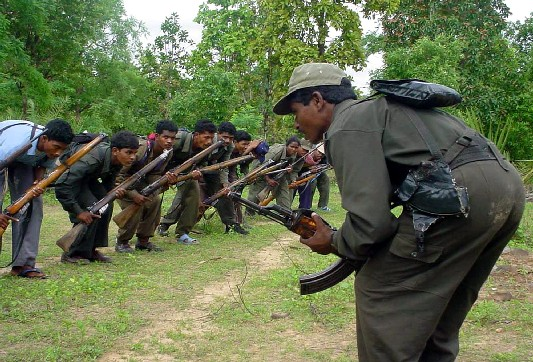
rebels, who have armed themselves to the teeth and who are fully trained in guerilla warfare.
“The attack by the Communist Party of India [CPI-Maoist] on a camp of the Eastern Frontier Rifles of West Bengal is another outrageous attempt by the banned organization to overawe the established authority in the state,” said Home Minister P Chidambaram.
Prime Minister Manmohan Singh has called the Maoist rebels – said to number about 22,000 and mostly residing in the jungles and tribal areas of eastern India with their ideological patrons in cities – the country’s biggest internal threat.
India’s Home Ministry officials in New Delhi were peeved at the lack of preparedness by the police force in West Bengal’s Silda camp as the rebels massacred them on Monday.
The police camp, ironically, was set up as part of an ongoing offensive against the rebels in the area. The operation was launched in June last year after the Maoists overran an area called “Lalgarh” in West Bengal and drove out police forces from there. The police took control of the area and since then the operation has continued.
“There has been a massive loss of life. Besides, more than 40 weapons were reported to have been looted,” admitted Chidambaram.
West Bengal’s communist government admitted to loopholes in security that led to the massacre, one of the most audacious in recent times.
“There was a breach of security. There was a lack of alertness on the part of our policemen,” conceded West Bengal chief minister Buddhadeb Bhattacharjee. A top police official and the state’s home secretary even bickered over intelligence input about the attack.
While West Bengal’s top cop Bhupinder Singh said police had no inkling of an impending attack, Home Secretary Ardhendu Sen said a gathering of the rebels was known, though not the specific target. “We will continue our operation against them. We are reviewing our strategy,” said Singh.
A top Maoist leader who identified himself as Kishenji called local TV stations in Kolkata shortly after the West Bengal massacre to claim responsibility.
“This is our ‘Operation Peace Hunt’. It is our retaliation against the ‘Operation Green Hunt’ of the government,” he said, referring to an ongoing offensive in the jungles by Delhi’s forces against the rebels. “We will continue to bleed them until the offensive against us is withdrawn.”
Defense analysts have flayed the government for failing to tackle the Maoist challenge. Ajay Sahni of the New Delhi-based Institute for Conflict Management says the West Bengal police force is too weak to fight the Maoists.
“Unless the forces are retrained, combating the rebels is impossible. The Maoists must not be able to move from one Indian state to another after a strike in one. They have to be trapped inside,” said Sahni.
“There should be sufficiency of force and resources. If the forces are dispersed, it is vulnerable. The forces must reach a saturation point at a place,” he said. “There should be quick reinforcement too. The Maoists mine these areas and often attack forces on the edges of the main deployment areas.”
According to economists and social commentators, the menace can be tackled partly by force and largely by development in the backward areas where the rebels gain ground owing to grinding poverty and hunger.
“The threat is real and growing. We need a cold-turkey policy now, and all eastern states must come together to counter the rebels,” said Abhirup Sarkar, an economist with the Indian Statistical Institute. “But development is the only real answer to solve the problem at its root.”
He expressed concern that the threat would largely affect industrialization in rural India. A steel plant touted as one of the biggest in India is due to be built in an area barely 60 kilometers from the scene of the Maoists’ latest attack.
Lack of coordinated political action also hampers the fight against the Maoists, said analysts. During a recent meeting of chief ministers of four eastern states – West Bengal, Bihar, Jharkhand and Orissa – convened by Chidambaram in Kolkata, only two were present.
While the Maoist movement began in the late 1960s in a northern town of West Bengal state called Naxalbari (they named themselves Naxals after the town) and then subsided in the 1970s, today the gangs of rebels now known as Maoists function under an outfit called the Communist Party of India (Maoist).
CPI (Maoist) was formed following the merger of the Maoist Communist Center of India and the Communist Party of India (Marxist-Leninist) People’s War (also known as the People’s War Group) in September 2004, inheriting the “annihilation of class enemies” ideology and use of extreme violence as a means to secure organizational goals.
The Maoists have sympathizers in the big cities of India. According to Kabir Sumon, an intellectual, singer and songwriter and now a member of parliament, military offensives are not going to stop the violence.
Maintaining that the villagers live in grinding poverty and plight, he said the Indian government, which is shored up by his Trinamool Congress party, should stop the offensive to bring the rebels to the table for talks. “I would request the prime minister, the home minister and my party chief to stop the offensive,” said Sumon.
But the government remains firm in its stand on the operation against the rebels. “We can talk only after they shun violence,” said Chidambaram. “I would like to hear the voices of condemnation of those who have erroneously extended intellectual and material support to the CPI (Maoist).”
“It is only if the whole country rejects the preposterous theses of the CPI (Maoist) and condemns the so-called ‘armed liberation struggle’ that we can put an end to the menace of Naxalism and bring development and progress to the people in the conflict zones.”
(Inter Press Service)
 Mohammed Abbasi