

By Syed Fazl-e-Haider
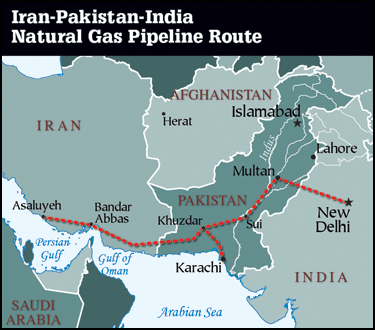
KARACHI – Islamabad and Tehran have signed an operational agreement on the Iran-Pakistan (IP) gas pipeline project, a month after the signing was delayed because Pakistan was unable to arrange funds for the project.
The countries signed a “heads of agreement” and certain “condition precedents” to make the gas sales purchase agreement (GSPA) signed last June effective. The signing of these agreements was required for the flow of Iranian gas towards Pakistan to begin in three to four years.
The pipeline as initially mooted was to carry gas from Iran to Pakistan and on to India. India withdrew from negotiations last year over disagreements on price and transit fees, but it is still open for the country to joint the agreement.
The United States, Pakistan’s largest aid donor, is reluctant to help Islamabad proceed with the multi-billion dollar pipelinebecause of the participation of Iran, perceived in Washington as seeking to build nuclear weapons. Some analysts believe that financial sanctions on Iran may delay but not force the cancellation of the pipeline, as China is also keen to join the project. Beijing may provide financial assistance to Islamabad to get the project started.
Under the GSPA, Iran will provide 750 million cubic feet of gas per day to Pakistan for the next 25 years. Initially, an offshore pipelinewas proposed, but the present plan is for an overland route from the South Pars fields in southern Iran.
Pakistani President Asif Ali Zardari and his Iranian counterpart, Mahmoud Ahmadinejad, signed a US$7.5 billion agreement in Tehran last May, finalizing the deal to transfer gas from Iran to Pakistan. Iran will initially send 30 million cubic meters of gas per day to Pakistan, to be increased to 60 million cubic meters per day.
Each country will be responsible for building the section ofpipeline that runs through its own territory. The Pakistan government had been unable to allocate proper financing and the US is not willing to give financial assistance in this regard, DawnNews reported, citing sources from Pakistan’s Ministry of Petroleum and Natural Resources.
The US has previously pledged all-out support in ensuring energy security for Pakistan, which suffers long and frequent blackouts amid an electricity shortfall of more than 3,000 megawatts. US companies, such as Carlyle Group affiliate 4Gas, Oklahoma-based Walters Co, and Global Edison, plan various energy-related projects in the country.
Critics say that the US interest in resolving Pakistan’s energy crisis is an attempt to foil the Iran pipeline project.
Beijing is interested in building a pipeline from Iran via Pakistan into China to secure an overland energy corridor less liable to interruption by US or other forces at times of international tension while also cutting out the 20,000 kilometer tanker route around the southern rim of Asia. Critics say that by opposing the IP project, the US is also trying remove this option for China.
China at present appears to be the sole country holding out against sanctions against Iran over its nuclear policy of the five veto-wielding members of the UN Security Council (the others are United States, Russia, Britain and France). The need for Iranianoil and gas is making it difficult for Beijing to agree withWashington on its stance against Tehran, according to a report in Dawn last month. Approving sanctions against Iran would mean the loss of 10% to 12% of China’s oil imports and of hundreds of billions of dollars worth of oil locked into futures contracts, while also ending about $80 billion in Beijing-backed development projects in Iran. If China joins the project, the pipeline would pass through Pakistan’s Northern Areas, now known as Gilgit-Baltistan, and into China via the Khunjerab Pass. The pipeline would roughly parallel strategic transport links China is developing between its remote western regions, including Xinjiang, and Gilgit-Baltistan.
Syed Fazl-e-Haider (www.syedfazlehaider.com) is a development analyst in Pakistan. He is the author of many books, includingThe Economic Development of Balochistan (2004). He can be contacted at sfazlehaider05@yahoo.co
 Mohammed Abbasi