

By Syed Fazl-e-Haider
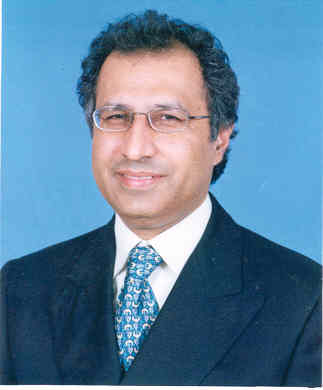
KARACHI – Former privatization minister Hafeez Shaikh has been appointed as Pakistan’s new finance advisor, a function previously carried out by finance minister Shaukat Tarin, who stepped down last month to focus on his private business interests.
Tarin’s successor faces enormous challenges, including soaring inflation, dwindling foreign investments, a depreciating rupee, stagnant exports and a rising cost of debt servicing. Shaikh, 55, confirmed that he had accepted the government’s offer to succeed Tarin as an advisor (not minister), according to the Business Recorder. Official notification in this respect is likely to be issued today. Shaikh is not a member of parliament, so will not be a full-fledged minister, but he is expected to have the same level of authority.
As finance advisor, Shaikh will lead the government team on economics and finance. He is expected to have the backing of the country’s business community, which in 2004 named him Pakistan’s “Man of the Year” in 2004 in recognition of his contributions to the country.
Shaikh was minister for finance, planning and development in Sindh province from 2000 to 2002 before being appointed federal minister for privatization and investment. His stint in the post from 2003-06 was widely considered successful, with 34 transactions worth over US$5 billion completed in a transparent fashion. Using the slogan of “Privatization for the People”, shares in several companies were given to 800,000 people, creating broad ownership. Foreign direct investment increased during the period to $5 billion from $1 billion.
He left the government in early 2006 to be general partner at an international investment company, headquartered in New York.
Inflation presents a key challenge to Shaikh, as it remains high after failing to drop by the extent the government had forecast.Consumer price index (CPI) inflation rose 13.02% in February on increased electricity, energy and food prices, according to the Federal Board of Statistics (FBS). In the first eight months of the present fiscal year, the CPI increased 11.08% from the year-earlier period.
Prices have increased 36.3% since President Asif Ali Zardari came to power in 2008, with those of two basic commodities, wheat flour and sugar, rising by 83% and 168%, respectively, according to the Dawn newspaper. The increases continue despite government promises to contain the trend and punish hoarders and profiteers.
Local analysts forecast that, in consequence, the central bank’s policy discount rate will remain unchanged at 12.5% at least until the financial year ends on June 30.
A widening trade deficit also has to be confronted. The monthly deficit widened by 10.48% in February to $964.64 million, from $873.15 million a year earlier, as textile goods, the mainstay of the export sector, lost ground to overseas competitors. Analysts fear that a further increase in the trade deficit will make the economy more vulnerable to external shocks.
Rejuvenating the economy with the help of overseas investors is increasingly difficult amid worsening security. Last week, two suicide attacks killed at least 60 people and injured more than 100 people in Lahore, the country’s cultural capital.
Foreign direct investment (FDI) declined 53% to $1.48 billion during from last July through February this year from the 12-month-earlier period, mainly due to poor law and order, according to the central bank. Net foreign investment, comprising FDI and portfolio investment, declined to $1.02 billion in July-February from $1.89 billion a year earlier.
Remittances from overseas Pakistani workers also fell in the period, by 8.2%, to $588.8 million.
Helping to see Pakistan through is an International Monetary Fundemergency loan package that now stands at $11.3 billion after initially being set at $7.6 billion in November 2008 to help avert a balance of payments crisis and shore up reserves.
The trade deficit for the July to February period did narrow to $9.42 billion from just below $11.7 billion a year earlier, according to the FBS, as imports declined while exports rose marginally. Analysts attributed this to the weak rupee, which has made Pakistani products cheaper for overseas buyers but has boosted prices for importers.
But overall, each rupee increase in dollar value costs the economy about more than 55 billion rupees, say economists. The country’s external debt and liabilities at the end of calendar 2009 was an unprecedented $55.67 billion, or about one-third of country’s gross domestic product.
The deficit could widen further in the coming months due to increased crude oil prices, according to The News. A shortage of compressed natural gas used in cars and other vehicles, is raising demand for oil and it could further drive up the import bill.
The government export target of $20 billion looks increasingly remote for this fiscal year, as total exports in the eight months to February reached only $12.4 billion, leaving a $7.6 billion gap to bridge in remaining four months.
Poor law and order has been a major reason for delays in meeting export deadlines agreed with international buyers, according to the Daily Times, with movement of raw materials from ports to manufacturing units and of exportable goods back to ports a major hurdle.
Exporters, particularly in the important textiles sector, are also being hit by power outages, gas shortages and high interest rates.
“It will be a wishful thinking to increase the export of value-added goods in the present situation, when even raw materials are not available in adequate quantity to run the industrial units in this sector,” the Daily Times reported a local textile exporter as saying.
Syed Fazl-e-Haider (www.syedfazlehaider.com) is a development analyst in Pakistan. He is the author of many books, includingThe Economic Development of Balochistan (2004). He can be contacted at sfazlehaider05@yahoo.com
 Mohammed Abbasi