

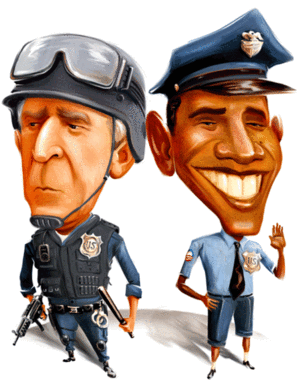
Checkered record of the world’s policeman
By Jeremy Kuzmarov
“In the police you see the dirty work of Empire at close quarters. The wretched prisoners huddling in stinking cages of the lock-ups, the grey cowed faces of the long-term convicts, the scarred buttocks of the men who had been flogged with bamboos.”
– George Orwell, Shooting An Elephant and Other Essays.
“The police interrogation rooms smelled of urine and injustice.”
– Graham Greene, The Quiet American.
As the United States expands the war in Afghanistan and Pakistan, the Barack Obama administration has placed a premium on police training programs. The stated aim is to provide security to the population so as to enable local forces to gradually take over from the military in completing the pacification process.
A similar strategy has been pursued in Iraq. American-backed forces have been implicated in sectarian violence, death squad activity and torture. At the same time, the weaponry and equipment that the US provided has frequently found its way into the hands of insurgents, many of whom have infiltrated the state security apparatus, contributing to the long-drawn out nature of both conflicts.
Ignored in mainstream media commentary and “think tank” analyses is the fact that the destructive consequences of American strategy in the Middle East and Central Asia today are consistent with practices honed over more than a century in the poor nations of the periphery.
Police training has been central to American attempts to expand its reach from the conquest of the Philippines at the dawn of the 20th century through the Cold War-era to today. Presented to the public in both the target country and the United States as humanitarian initiatives designed to strengthen democraticdevelopment and public security, these programs achieved neither, but were critical to securing the power base of local elites amenable to US economic and political interests and contributed to massive human-rights violations. They helped to facilitate the rise of powerful anti-democratic forces, which operated above the law, contributing to endemic violence, state terrorism and corruption.
Quite consistently across time and space, American policy-makers have supported police suppression of radical and nationalist movements as a cost-effective and covert means precluding costly military intervention which was more likely to arouse public opposition.
During the mid 1960s, the Director of United States Agency of International Development (USAID) David Bell commented in congressional testimony that “the police are a most sensitive point of contact between the government and people, close to the focal points of unrest, and more acceptable than the army as keepers of order over long periods of time. The police are frequently better trained and equipped than the military to deal with minor forms of violence, conspiracy and subversion.”
Robert W Komer who served as a National Security Council advisor to President John F Kennedy further stressed that the police were “more valuable than Special Forces in our global counter-insurgency efforts” and particularly useful in fighting urban insurrections.
“We get more from the police in terms of preventative medicine than from any single US program,” he said. “They are cost effective, while not going for fancy military hardware. They provide the first line of defense against demonstrations, riots and local insurrections. Only when the situation gets out of hand (as in South Vietnam) does the military have to be called in.”
These remarks illuminate the underlying geo-strategic imperatives shaping the growth of the programs and the mobilization of police for political and military ends, which accounted for widespread human rights abuses.
This article, drawing on declassified US government archives, examines some of the landmark instances in the historicaldevelopment of American police training programs to highlight the origins of current policies in the killing fields of Afghanistan and Iraq.
Over the years, as US imperial attention has shifted from one region to another, police training and financing has remained an unobserved constant, evolving with new strategies and weapons innovations but always retaining the same strategic goals and tactical elements. Staffed by military and police officers who valued order and discipline over the protection of civil liberties, the programs were designed to empower pro-US regimes committed to free-market capitalist development and helped to create elaborate intelligence networks, which facilitated the suppression of dissident groups in a more surgical way.
The US in effect helped to modernize intelligence gathering and political policing operations in its far-flung empire, thus magnifying their impact. These further helped to militarize the police and fostered, through rigorous ideological conditioning, the dehumanization of political adversaries. The result was a reign of torture and terror as part of police practice in countries subject to US influence, the devolution of police forces into brutal oppressors of the indigenous population, and the growth of corruption levels pushing regimes towards kleptocracy.
In his trilogy on the American empire, Chalmers Johnson demonstrates how the US has historically projected its global power through a variety of means, including economic blackmail and the manipulation of financial institutions, covert operations, arms sales, and most importantly, through the development of a global network of military bases whose scale dwarfs all previous empires, including Rome. This article seeks to add another important structural dimension of US power, namely the training of police and paramilitary units under the guise of humanitarian assistance, which preceded and continued through the era of global military bases.
Colonial policing and state terror in the Philippines
In 1898, seeking access to the vast “China market” and building the foundation of its seizure of Hawaii, the US entered the great “imperial game” through its colonization of the Philippines. From 1899-1902, the military waged a relentless campaign to suppress the nationalist movement for independence, resulting in the death of perhaps two million Filipinos and the destruction of the societal fabric.
As the fighting waned, the Philippines Commission under future president William H. Taft focused on building an indigenous police force, officered by Americans, which was capable of finishing off the insurgents and establishing order. The constabulary engaged in patrols for over a decade to suppress nationalist and messianic peasant revolts in the countryside. It frequently employed scorched earth tactics and presided over numerous massacres, including killing hundreds of civilians at Bud Dajo in the Moro province of Mindanao, where Muslims refused to acquiesce to American power and rule.
As Alfred W McCoy documents in his outstanding new book,Policing America’s Empire: The United States, the Philippinesand the Rise of the Surveillance State, the constabulary’s success in serving US imperial interests owed largely to the role of military intelligence officers in imparting pioneering methods ofdata management and covert techniques of surveillance, which were appropriated by domestic policing agencies, including theFederal Bureau of Investigations (FBI), during the 1st Red Scare.
Under the command of Harry H Bandholtz, the constabulary’s secret service became especially effective in adopting psychological warfare techniques, such as the wearing of disguises, fabricating disinformation and recruiting paid informants and saboteurs in their efforts to “break up bands of political plotters”. They monitored the press, carried out periodic assassinations and compiled dossiers on thousands of individuals as well as information on the corruption of America’s Filipino proxies as means to keep them tied to the occupation.
One of the major technical achievements was an alarm system, which ended dependence on the public telephone. American advisors further imparted new administrative and fingerprinting techniques, which allowed for an expansion of the police’s social control capabilities. The declaration of martial law ensured minimal governmental oversight and facilitated surveillance and arrests without due process. Torture, including the notorious water cure, was widely employed.
After the suspension of the writ of habeas corpus in Cavite and Batangas due to heavy guerrilla activity, William Cameron Forbes, a grandson of philosopher Ralph Waldo Emerson who served as commissioner of commerce and police from 1904 to 1908 and governor general from 1909-1913, noted in his journal that “the constabulary was now free to run in the suspects. A lot of innocent people will be put in jail for a while, but it will also mean that some guilty ones will be caught and the cancer will be cut”. These comments exemplify the ends justifies the means philosophy underpinning the abuse of human rights, which was characteristic of later interventions as well.
Racism was another prominent factor. Henry T Allen, the first chief of the constabulary, characteristically referred to Filipinos resisting the US as suffering from “intense ignorance” and the “fanatical” characteristics of “semi-savagery”. He added, in a letter to Taft, that “education and roads will effect what is desired, but while awaiting these, drastic measures are obligatory … The only remedy is killing and for the same reason that a rabid dog must be disposed of.”
In his memoir, Bullets and Bolos, constabulary officer John R White, who went on to serve with the US military in World War I, recounts how his men razed houses, “plundered all that they could carry away” and destroyed sugar and other foodstuffs in the attempt to isolate and starve the Moro enemy in Mindanao. In the end, they left the pretty plateau a “burned and scarred sore”. This was hard, he wrote, “but necessary for we did not want the job of taking Mindanao again”. The tactics pioneered in the Philippines paved the way for later American action under the Strategic Hamlet program in South Vietnam.
The constabulary ultimately succeeded in infiltrating and sowing dissension within radical organizations, including an incipient labor movement, contributing to their implosion. It even played a role in apostolic succession by undermining the influence of Bishop Gregorio Aglipay through the spread of disinformation. Aglipay was a nationalist with socialist sympathies whose services were attended by thousands of the urban poor.
The legacy of political repression and corruption survived long after the Philippines was granted independence in the mid 1930s. The constabulary and police have maintained their notoriety for brutality, right up to the present, as new waves of repression and violence are being launched under the guise of the “war on terror.”
‘Popping off Cacos’: The US Gendarmerie and racial slaughter in Haiti
American policies in the Philippines were replicated in the Caribbean during the colonial occupations of the 1910s and 1920s, where they contributed to the spread of considerable violence and repression. In Haiti, the US Gendarmerie was the brainchild of Franklin D Roosevelt, who, influenced by his cousin, Teddy, viewed the creation of a local police force as a cost-effective means of advancing US reach. The gendarmerie was mobilized primarily to fight against nationalist rebels, known as the Cacos, and to oversee brutal forced labor regiments imposed by the United States.
As in the Philippines, the United States provided modern police technologies, including communications equipment and fingerprinting techniques, and worked to improve administration and records collection to aid in the monitoring of dissident activity. In a prelude to the Cold War, riot control training was also provided to facilitate the crack down on urban demonstrations and strikes. American officers taunted people using racial epithets and did not usually object when rioters were badly beaten and clubbed, sometimes to death.
Journalist Samuel G Inman observed that the gendarmerie enjoyed practically “unlimited power” in the districts where they served, creating opportunities for extortion and kickbacks. “He is the judge of practically all civil and criminal cases, the paymaster for all funds from the central government and ex-officio director of the schools inasmuch as he pays the teachers. He controls the mayor and city council since they cannot spend funds without his OK. As collector of taxes, he exercises a strong influence on all individuals in the community.” These comments exemplify the consequences of US policy in giving too much power to police units, resulting in systematic abuse.
The gendarmerie was especially valued for obtaining intelligence and adopted, as a precursor to the Central Intelligence Agency (CIA), psychological warfare (psy-war) tactics, including the spread of disinformation, the playing on native superstitions, and use of disguises to induce defections and infiltrate enemy camps.
One of the gendarmerie’s chief psy-war experts, Captain Herman H Hanneken blackened his skin, disguised himself as a Caco and bribed a bodyguard to gain access to the camp of leader Charlemagne Peralte, who became known as the “black Christ” after images of his decapitated body strung up on a cross were disseminated for intimidation purposes. Political terrorism would remain a feature of American counter-insurgency strategy through the Vietnam War-era and continuing today in Afghanistan and Iraq.
The violence that was endemic to the American occupation of Haiti was in large part racial. On search and destroy missions, “popping off” Cacos was likened to a sport, much like with the “pulajanes,” “ladrones” and “gu-gus” in the Philippines, and later the “gooks” in Vietnam.
Colonel Robert Denig noted in his diary that “life to Haitians is cheap, murder is nothing”. Lieutenant Faustin Wirkus added that killing Haitian rebels was like playing “hit the nigger and get a cigar games” at amusement parks back home. After the Caco movement was destroyed and the Marines were withdrawn, the US continued to arm and train the gendarmerie which it recognized as a pivotal instrument of power.
Following a period of military rule in the 1940s, Francois “Papa Doc” Duvalier used the police to suppress political dissent, orchestrating what internal reports referred to as “an active campaign of harassment and terrorism all over the country”. This fits in with a broader regional pattern, as the US-created National Guard evolved into the political instrument of dictators Anastasio Somoza in Nicaragua and Rafael Trujillo in the Dominican Republic, both having emerged from police ranks.
The police programs thus contributed not only to the spread of political violence in suppressing anti-occupational resistance, but also paved the way for an era of strong-armed rule and state terrorism after American colonial occupations formally ended.
Police training and political terror in South Vietnam
Building off the techniques pioneered in previous interventions, police training programs were an integral part of American counter-insurgency strategy in Vietnam, where they aided in the creation of an Orwellian-style police state and helped to stoke civil conflict.
Training began in 1955 as a centerpiece of America’s “nation-building” campaign on behalf of president Ngo Dinh Diem, who replaced French puppet emperor Bao Dai following the temporary division of the country under the 1954 Geneva Accords. Valued by the US for his anti-communism, Diem had little interest in developing a Western-style democracy and wanted to establish his own political dynasty. The principal US motive was to contain the spread of the Chinese revolutionary movement, which threatened the Open Door policy. The Dwight D Eisenhower administration refused to allow mandated elections to unify the country, which it knew would be won by the revolutionary leader Ho Chi Minh, whom the State Department referred to as the “ablest” and “most charismatic leader” in the country.
The police operation was run by Michigan State University (MSU) faculty under contract with the State Department. Much like in the Philippines and Haiti decades earlier, the United States stressed mass surveillance capable of monitoring subversion and dismantling the political opposition to Diem.
New technologies hastened the scale of violence associated with these efforts, though proved limited in engendering a favorable outcome for the United States. American advisors urged police to develop a more efficient record gathering system and modeled theSurete (civil police force) after the American FBI, arming it with 12-gauge shotguns, sedans, ammunition, and riot-control equipment to counter subversion. There were few pretenses from the beginning that the police were anything but a political instrument, with many top officials, including Surete Director Nguyen Ngoc Le, having been previously trained by France.
The MSU team developed an identity card system to monitor political activity as part of Diem’s anti-communist denunciation campaign. Those found with links to the Vietminh, who had led the liberation struggle against France, were arrested and faced torture at an assortment of prison camps, or were “disappeared,” as internal reports noted. Even Diem’s own chief of staff, Tran Van Don, derided the use of “Gestapo-like police raids and torture” against “those who simply opposed the government”.
US support was crucial in shaping South Vietnam’s evolution into what Foreign Affairs described as a “quasi-police state marred by arbitrary arrests, censorship of the press and the absence of political opposition”. The passage of law 10/59 allowing for the execution of regime opponents resulted in the declaration of armed resistance by the National Liberation Front (NLF), whose leader, Nguyen Huu Tho was rescued from house arrest through infiltration of Diem’s police by revolutionary supporters.
Starting in 1961, after taking over from Michigan State, the United States Agency for International Development’s Office of Public Safety (OPS) sent advisers to Malaya for counter-guerrilla training. Over the next fourteen years, working with the Public Safety Division of the US Operations Mission to Vietnam (USOM), the OPS provided more than 300 advisers and $300 million towards this goal, bolstering the number of police from 16,000 to 122,000.
They funded eight specialized training schools and built over 500 rural police stations and high-tech urban headquarters equipped with firearm ranges, computer systems and padded interrogation rooms. The OPS also helped to create a telecommunications network linking police headquarters in rural villages to major cities such as Saigon.
As in the Philippines and Haiti, emphasis was placed on building a corps of informants and developing a climate of fear to intimidate those who might challenge the government. To this latter end, psychological warfare teams painted a ghostly eye on the doors of houses suspected of harboring “Vietcong” agents. Penetration by the NLF, however, and a lack of conviction on the part of American trained forces helped to stymie these efforts, to the frustration of many American advisors who could not get around the strength of Vietnamese nationalism and political dynamic underlying the civil war. Language and cultural barriers and an underlying paternalism further strained social relations and made communications difficult, limiting effectiveness.
In May 1963, as opposition to Diem’s rule intensified, police killed nine monks, as well as three women and two children at a rally against religious persecution and government violence. In July, according to OPS adviser Ray Lundgren, in spite of the “amazing results” yielded by riot control courses, police again displayed “unnecessary brutality” in suppressing a peaceful Buddhist rally against repeated injustices, beating monks and other civilians.
In November, Diem was overthrown in a coup d’etat and replaced by a revolving door of generals, including ultimately Nguyen Cao Ky and Nguyen Van Thieu, who had served under the French and were implicated in the narcotics trade. The US in turn invaded and launched massive bombing campaigns which decimated the South Vietnamese countryside.
In an attempt to maximize social control in the face of mounting popular resistance, the OPS expanded the surveillance program first initiated by Michigan State, issuing identity cards to everyone over 15 and compiling dossiers on the political beliefs of nearly 12 million people. Once dissidents were identified, the police undertook night sweeps in their villages and “arrested anyone under the remotest suspicion of being left-wing”, as one witness put it. “The government has a blacklist of suspects, but I understand that wives, mothers and fathers – anyone with the slimmest association with those on it are being caught in the net.”
Many of those taken in were peace activists, students, members of oppositional groups like the Hoa-Hao and Cao Dai sects, and politicians who were seen as threats to the reigning junta. Echoing his predecessors in previous interventions, CIA Station Chief Douglas Blaufarb rationalized the repression on the grounds that “it was futile to have expected in the circumstances a punctilious regard in all cases for the niceties of civil rights”. Racism and the perceived inferiority of the Vietnamese “gooks” lay behind wide-scale human-rights violations.
Some of the worst abuses took place within the prison system overseen by the OPS. Conditions were described as “nightmarish”, “appalling” and equivalent to “hell on earth”, stemming largely from the rampant overcrowding caused by the influx of political prisoners.
Inmates were packed into tiny cells, where they had to sleep standing up or in shifts, and deprived of proper food, bathing facilities and medical attention. At Kien Tung Provincial Prison, just 10 kilometers from the seat of government, William C Benson of the OPS reported that the cells were “extremely dirty and the stench so nauseating” that it made him sick.
In An Xuyen, OPS advisor Donald Bordenkircher, who three decades later was appointed to head the Abu Ghraib prison facility in Iraq, wrote to his superiors that inmates had to sleep next to their own urine and feces and that the kitchen doubled as a trash dump and was inhabited by giant rats which were “as large as cats”.
Known as a stern disciplinarian, Bordenkircher embodies the continuity in American policies from Vietnam to Iraq, Afghanistan and the United States itself, where as town sheriff in Moundsville Virginia in 1986, he played a key role in crushing an inmate rebellion arising from wretched prison conditions.
Torture including sensory deprivation, rape, lashings and the use of electroshocks was widely documented in facilities under US oversight in Vietnam.
Frank Walton, head of the OPS in Vietnam and a former Los Angeles Police Department (LAPD) chief, sanctioned a report stating that non-cooperative prisoners, whom he referred to as “reds who keep preaching the commie line”, were “isolated in their cells for months” and permanently “bolted to the floor or handcuffed to leg-irons”, which was standard practice shaped by the war climate.
Not surprisingly, the prisons provided an important base of recruitment for the revolutionary forces, contributing to their ultimate victory in 1975. After a tour of penal facilities in the Mekong Delta, senior American adviser John Paul Vann commented, “I got the distinct impression that any detainees not previously VC [Viet Cong] or VC sympathizers would almost assuredly become so after their period of incarceration.”
Police programs in Vietnam culminated in the notorious “Operation Phoenix”, whose aim was to eliminate the Viet Cong infrastructure (VCI) through use of sophisticated computer technology and intelligence gathering techniques, and improved coordination between military and civilian police intelligence agencies. In practice, Phoenix spiraled out of control and led to indiscriminate violence.
Internal reports pointed out the widespread corruption of American-trained cadres who used their positions for revenge and extortion, threatening to kill people who refused to pay them huge sums. “VC avenger units,” regularly mutilated bodies and killedfamily members of suspected guerrillas. While the quantity of “neutralizations” was reported to be very high in many districts, there were “flagrant” cases of report padding, most egregiously in the province of Long An where Phoenix advisor Evan Parker Jr noted that “the numbers just don’t add up”. Dead bodies were being identified as VCI, rightly or wrongly, in order to fulfill quotas.
The catalogue of agents listed as killed included an inordinate number of “nurses”, which was a convenient way to account for women killed in raids on suspected VC hideouts. A Phoenix operative who had served in Czechoslovakia during World War IItellingly commented, “The reports that I would send in on the number of communists that were neutralized reminded me of the reports Hitler’s concentration camp commanders sent in on how many inmates they had exterminated, each commander lying that he had killed more than the other to please Himmler.”
These comments epitomize how the police training programs helped to facilitate state repression and terror under the rubric of internal security and modernization. The attempt at social control through imposition of an Orwellian regime of mass surveillance and torture lay at the root of the wide-scale humanitarian abuses, which fit with a much larger historical pattern.
The violence comes full circle in AfPak and Iraq
The violent history of US imperial intervention is being played out today in Afghanistan and Iraq, where police training programs are central to American-backed political repression and terror. Management of the programs has been especially poor given cultural and language barriers, deeply entrenched hostility towards foreign intervention among the population, and administrative incompetence.
In addition, the problems have been exacerbated by the increasing reliance on private mercenary corporations such as DynCorp and Blackwater (re-named Xe), and on tainted police advisors linked to human-rights violations and malfeasance.
In Afghanistan, after almost nine years and $7 billion spent on training and salaries, an internal report concluded that “nepotism, financial improprieties and unethical recruitment practices were commonplace” among the American-backed forces, which engaged in widespread criminal activity and bribery and were “overmatched in counter-insurgency and counter-narcotics operations”.
American police advisors, whose background as small town cops did little to prepare them for policing in a war zone, made six figure salaries, 50 times more than their Afghan counterparts, who resented their presence. According to a recent poll, less than 20% of the population in the eastern and southern provinces trusted the police, who are poorly motivated and whose poor performance has contributed to political instability and the resurgence of the Taliban.
A taxi driver interviewed by RAND Corporation analyst Seth G Jones tellingly commented, “Forget about the Taliban, it is the police we worry about.”
Despised and feared, the Afghan national police have been continuously controlled by ethnic warlords paid off by the CIA and are central to what Ambassador Ron Neumann characterized as the pattern of “repression and oppression” gripping the country.
They have routinely engaged in shakedowns at impromptu checkpoints, shot at and killed stone-throwing or unarmed demonstrators, stolen farmers’ land, and terrorized the civilian population while undertaking house-to-house raids in military-assisted sweep operations. They have further intimidated voters during fraudulent elections, including the one that brought President Hamid Karzai back to power in 2009. According to village elders in Babaji, police bent on taking revenge against clan rivals carried out the abduction and rape of pre-teen girls and boys.
These kinds of abuses fit with a larger historical pattern, and are a product of the ethnic antagonisms and social polarizations bred by the US intervention, and the mobilization of police for military and political ends.
The open support by the George W Bush administration for torture and other harsh methods strengthened the proclivity towards indiscriminate violence.
The International Red Cross reported massive overcrowding in Afghan prisons, “harsh” conditions, a lack of clarity about the legal basis for detention, and people being held “incommunicado” in isolation cells where they were “subjected to cruel treatment in violation of the Geneva Conventions”. An undisclosed number have died in custody, including several thousand who were transported under the oversight of CIA-backed warlord Rashid Dostum in unventilated containers, where they suffocated to death or were shot.
Corruption has been a major problem as police routinely accept kickbacks from black-market activities. Fitting a historical pattern, the State Department and CIA have maintained close ties with top officials who are directly involved in the narcotics trade, causing production to rise to over 8,000 tons per annum. The president’s own brother, Ahmed Wali, a CIA “asset” who heads a paramilitary group used for raids on suspected Taliban enclaves has used allegedly used drug proceeds to fund state terror operations, including the intimidation of opponents in the election of 2009.
Karzai’s 2007 appointment as anti-corruption chief, Izzatullah Wasifi, meanwhile, spent almost four years in a Nevada prison for trying to sell heroin to an undercover police officer. A CIA officer commented that during the US-NATO occupation, “Virtually every significant Afghan figure has had brushes with the drug trade. If you are looking for Mother Theresa, she doesn’t live in Afghanistan.”
Cheryl Bernard, a RAND analyst and wife of Zalmay Khalilzad, UN Ambassador of the Bush administration, explained one of the key reasons for the lack of good governance: “To defeat the Soviets we threw the worst crazies against them. Then we allowed them to get rid of, just kill all the moderate leaders. The reason we don’t have moderate leaders in Afghanistan today is because we let the nuts kill them all. They killed all the leftists, the moderates, the middle of the roaders. They were just eliminated, during the 1980s and afterwards.”
The US continues to tolerate high-levels of corruption out of perceived geopolitical expediency, claiming that it is engrained within the political culture of Afghanistan and other “backward nations” in which it intervenes. In reality, however, it is a product of historical contingencies, the breakdown of social mores caused by the war-climate and the need of elite officials lacking popular legitimacy to obtain money for counter-insurgency operations.
Similar factors were at play in the 1960s when Vietnam and Laoswere at the center of the world drug trade, benefiting from American backing of corrupt officials who controlled the traffic, with the CIA overseeing the production and sale of opium by Hmong guerrillas in order to finance the secret war against the Pathet Lao.
History is thus coming full circle in Afghanistan, which now produces 93% of the world’s heroin and has been characterized by even Fox News, a major champion of American intervention, as a “narco-state”.
Drug money has corrupted all facets of society, crippled the legal economy and made it nearly impossible to carry out the simplest development projects while most of the population lives in crushing poverty. As in South Vietnam under US occupation, the main airport has become a major trans-shipment point for heroin and positions for police chief in many provinces are auctioned off to the highest bidder due to their enormous graft value. Securing a job as chief of police on the border is rumored to cost upwards of $150,000.
In another parallel to Vietnam, rampant human-rights violations have driven many people into the arms of the insurgency. A 2009 report by Commanding General Stanley A McChrystal describes Afghan prisons as a particularly important recruiting base and “sanctuary [for Islamic militants] to conduct lethal operations” against government and coalition forces, including the 2008 bombing of the Serena hotel in Kabul which was allegedly planned without interference from prison personnel.
McChrystal, a former Special Forces assassin, notes that “there are more insurgents per square foot in corrections facilities than anywhere else in Afghanistan”. These comments suggest that the recent Obama “surge” represents a costly and futile escalation of a conflict in which the US has no prospects of victory.
Beginning in 2004, as war increasingly spilled over into Pakistan, the State Department provided tens of millions of dollars in technical aid, training and equipment to the Pakistani police. The central aim was to fight the Taliban and consolidate the power of military dictator Pervez Musharraf and his successor Ali Asaf Zhardari.
American advisors introduced a computerized security and evaluation system to monitor all movement across the border, created special counter-narcotics units and a police air wing which was supplied with three caravan spotter planes and eight Huey helicopters to aid in counter-insurgency operations. Police play a vital role alongside mercenary firms such as Xe operations in identifying targets for CIA predator drone attacks which have killed hundreds of civilians, including over 100 during an errant strike on the village of Bola Baluk.
As in Afghanistan, militarization has enhanced the already repressive character of the police and contributed to the intensification of a vicious civil war in which over two million people have been rendered refugees. Pakistan’s Inter-Services Intelligence (ISI) meanwhile is deeply caught up in the heroin traffic, with the usual CIA collusion, and has been infiltrated by pro-Taliban elements, revealing the futility of American training programs and intervention.
In Iraq, much as in Vietnam three decades earlier, American training programs have contributed to the shattering of the societal fabric. The mission was initially headed by Bernard Kerik, former New York City police commissioner who won fame in leading rescue efforts at ground zero after the September 11, 2001 attacks and was later convicted and sentenced to four years in prison on charges of tax fraud and public corruption.
In spite of hundreds of millions in funding, the Iraqi National Police (INP) remains under-equipped and riddled with cronyism and corruption. Police were so poorly motivated and paid that many sold their bullets and uniforms on the black market.
Historically, the forces trained by the United States to subdue their own countrymen have taken on the air of paid mercenaries with little loyalty to their benefactor or the cause that they purportedly represent. Iraq is no exception to this general rule.
A State Department report noted that because of poor morale, Iraqi police have been rendered “ineffective and have quit or abandoned their stations”. They were infiltrated by sectarian militias who used American weapons to engage in ethnic cleansing and brazenly drove through city streets in daylight hours with dead bodies in the backs of their trucks.
Militarized units routinely fired into crowds of unarmed demonstrators and had a history of going on forays into Sunni neighborhoods just to punish civilians. Several dozen investigative journalists and 200 prominent academics who opposed the US invasion were among those assassinated. Jerry Burke, one of the original police trainers who served two tours in Iraq, told reporters in 2007 that the INP was unsalvageable and that many of its members should be prosecuted for criminal human-rights violations, war crimes and death squad activities.
A central US focus was on training heavily armed commando units, recruited from Saddam Hussein’s Special Forces after the reversal of the de-Ba’athification policy, whose primary mission was to “neutralize” high level insurgents.
American strategy in this respect was modeled after the Phoenix program in Vietnam, of which Vice President Dick Cheney was particularly enamored, and also bore heavy resemblances to practices in Central America during Ronald Reagan’s terrorist wars of the 1980s. In 2004, Cheney openly called for the “Salvador option,” referring to the US role in training paramilitary units to assassinate left-wing guerrilla leaders and their supporters during El Salvador’s dirty war, largely with the aim of intimidating the population into submission.
James Steele’s appointment as a top adviser to Iraq’s most fearsome counterinsurgency force, the 5,000 man Special Police Commandos, exemplified the continuity in US policy. Steele served with the Green Berets in Vietnam, further honed his tactics training Contra forces in Nicaragua in the 1980s, then led a special forces mission in El Salvador where his men were implicated in serious human-rights abuses, including “disappearances,” torture and the massacre of civilians.
Journalist Dahr Jamail wrote that it was no coincidence daily life in Iraq came to resemble “what the death squads generated in Central America … Hundreds of unclaimed dead at the morgue – blood-caked men who had been shot, knifed, garroted or apparently suffocated by the plastic bag still over their heads. Many of their bodies were sprawled with their hands still bound”.
By training and arming Iraqi police officials notorious for corruption, beatings, kidnappings and mass executions, American advisors contributed to the bloodbath in Iraq. The continuity in personnel and practice from past interventions shows the violent consequences of US training programs.
American advisors favored hard-line commanders, like Adnan Thabit, whom close aides compared to the “godfather” and who threatened to kill the one journalist brave enough to interview him. On October 5, 2006, US military forces removed the entire 8th brigade of the 2nd National Police Division from duty and arrested its officers after the brigade was implicated in the raid of a food factory in Baghdad and the kidnapping of 26 Sunni workers, seven of whom were executed. The Los Angeles Times reported that at the Baghdad morgue, “dozens of bodies arrive at the same time on a weekly basis, including scores of corpses with wrists bound by police handcuffs”.
In December 2006, the Iraq study group portrayed a grave and deteriorating state of affairs, noting that “the Shi’ite dominated police units cannot control crime and they routinely engage in sectarian violence, including the unnecessary detention, torture and targeted execution of Sunni Arab civilians. Many police participated in training in order to obtain a weapon, uniform and ammunition for use in sectarian violence.”
A Human Rights Watch report around the same time detailed police methods of interrogation in which prisoners were “routinely” beaten with cables and pipes, shocked, or suspended from their wrists for prolonged periods of time – tactics associated with Hussein’s dictatorship. Iraqis frequently complained of police breaking into homes, extorting money for ransom and arbitrarily conducting arrests. One interviewee commented, “This isn’t a police force, it’s a bunch of thugs.” What all these reports ignore is the systematic US responsibility for the training and methods that produced such outcomes.
As a symbol of foreign oppression, the INP became the frequent target of insurgent attacks. Nearly 3,000 police were killed and over 5,000 injured between September 2005 and April 2006 alone. In a reflection of the violent climate bred by the occupation, a number of high-ranking police officers, including the head of the serious crimes unit in Baghdad, were shot dead by US soldiers who thought that they were suicide bombers. Iraqi police have condemned the Americans as cowardly for not taking the same risks to their lives as they were ordered to take, and for being better protected from attack.
A police lieutenant in Baghdad commented that “the [Americans] hide behind the barricades while we are here in the streets without even guns to protect ourselves”.
As in the Philippines, Haiti and Vietnam earlier, American advisors held racial stereotypes of Iraqis and a paternalistic and colonial mindset that bred resentment. In a memoir of his year in Iraq, Robert Cole, a police officer from East Palo Alto, California and a DynCorp employee, explains that these attitudes were engrained in a mini-boot camp training session, where he was “brainwashed, reprogrammed and desensitized” and “morphed” into a “trained professional killer”.
Cole reports being told to shoot first and think later and to instruct police to do the same. “If you see a suspicious Iraqi civilian, pull your weapon and gun him down,” he was told, “you don’t fire one or two shots … You riddle his sorry ass with bullets until you’re sure he’s dead as a doorknob.”
This is an inversion not only of democratic police methods but even of Western counterinsurgency doctrine which, at least in theory, advocates a moderation of force in order to avoid antagonizing the population and creating martyrs for the revolutionary cause. It is no wonder that the scope of violence and human-rights abuses in Iraq has been so high. In spite of all the bloodshed and negative reports, however, the Iraq Study group actually recommended expanding American police training in the misconceived belief that more resources and aid could help professionalize the force (as Obama is now doing in Afghanistan).
This was a crucial dimension of the much vaunted “surge”. Efforts were initiated to include Sunnis in the police and purge corrupt members who engaged in sectarian violence, including the head of the Ministry of the Interior, Bayan Jabr, a Shi’ite extremist who oversaw a torture chamber beneath his offices in which survivors were found with drill marks in their skulls. Nonetheless, extrajudicial violence and killings have remained endemic. On March 16, 2009, the New York Times reported, for example, that police officers abducted and killed six prisoners released from Camp Bucca in revenge for their days as insurgents. These actions appear to be routine.
Since the “surge,” police have been delegated more responsibility in manning checkpoints and aiding in combat operations, thus increasing opportunities for extortion and abuse. To what end? Robert M. Witajewski, a top civilian police trainer and director of the embassy’s Law Enforcement and Correctional Affairs program expressed concern that in “over-militarizing the police”, the US was potentially “creating an entity that could cause a coup down the road”.
There are plenty of historical examples which bear out these fears. Few in Washington appear, however, to acknowledge them.
In response to the wave of neo-conservative analysts extolling the virtues of empire in the aftermath of 9/11, Chalmers Johnson writes in Nemesis: The Last Days of the American Republic that the idea of “forcing thousands of people to be free by slaughtering them – with Maxim machine guns in the 19th century, or ‘precision munitions’ today – seems to reflect a deeply felt need as well as a striking inability to imagine the lives and viewpoints of others”. He added that “all empires require myths of divine right, racial pre-eminence, manifest destiny or a ‘civilizing mission’ to cover their often barbarous behavior in other people’s country”.
American imperial intervention throughout the long century from the conquest of the Philippines through the ongoing wars in Afghanistan and Iraq has indeed sown much human misery and violence.
While it has helped to vanquish some genuinely totalitarian forces, such as the Nazis and imperial Japanese, all too often those at the wrong end of the guns have been supporters of nationalist and social revolutionary movements seeking badly needed social change. Many were driven underground through repression and as a result of the US refusal to implement internationally sanctioned diplomatic settlements, such as the Geneva Accords of 1954 in Vietnam. Like previous colonial powers, the US has also often helped to exacerbate ethnic divisions and conflict, as in Afghanistan and Iraq today, with disastrous results.
US police training programs exemplify the dark side of the American empire. They have been crucial in advancing American power and in perpetuating and even creating the particular types of repressive regimes that emerged under US guidance – namely regimes which were dependent on foreign aid for their survival and developed repressive surveillance and internal security apparatuses to quash dissent.
While American strategic planners hoped that the police programs could provide the social stability for liberal-capitalist development to take root, the programs often spiraled out of control and empowered rogue forces, which used the modern weaponry and resources to advance their own power and to suppress personal rivals.
American police training furthermore spawned endless cycles of violence and in turn contributed to the delegitimizing of American client regimes and the empowerment of resistance movements because of the abuses that they inflicted. Police programs epitomize the limits of American social engineering efforts and power and unintended consequences of US covert manipulation.
Many of the worst features of American police training programs have been evident in the contemporary occupations of Afghanistan and Iraq, which sought to incorporate methods that were honed in previous interventions. That these methods bred horrific consequences was of little importance to policy-makers for whom the ends seemingly justify the means.
While differing political contexts have ensured different results historically, there are some patterns that emerge as universal, namely the role of the United States in imparting sophisticated policing equipment and trying to professionalize the internal security apparatus of client regimes as a means of fortifying their power and repressing the political opposition.
New technologies have been developed to try and hasten the efficiency of this latter task, though the overriding goal has remained the same, from the Philippines occupation forward.
American society is at a crossroads: it can continue to pursue the destructive path of empire, leading to endless cycles of violence and warfare as well as environmental degradation and economic hardship and political repression at home, or it can adopt a more humble, non-violent approach to foreign policy and thus serve as a beacon for world peace while redirecting the country’s resources towards constructive ends.
There is still time to embrace the non-violent option, although the Obama administration is moving in the wrong direction, and time is getting short if our civilization is to survive with its moral integrity intact.
Note
1.) A fully annotated version of this article is available at Japan Focus.
Jeremy Kuzmarov is an assistant professor of history at the University of Tulsa and author of The Myth of the Addicted Army: Vietnam and the Modern War on Drugs. He wrote this article for The Asia-Pacific Journal.
(This article was first published by Japan Focus. Republished with permission from Japan Focus.)
 Mohammed Abbasi