

By Brian McCartan
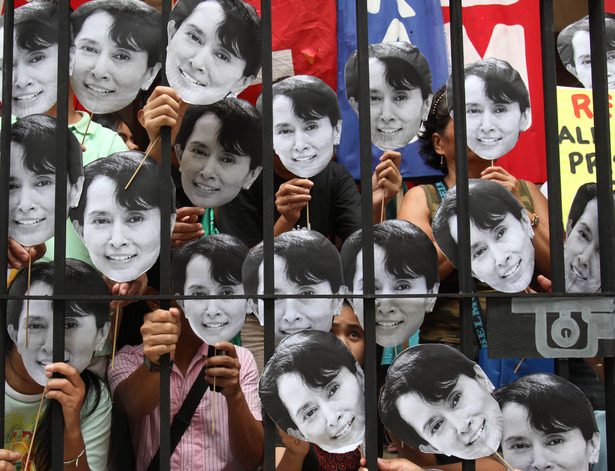
BANGKOK – Myanmar’s detained pro-democracy leader Aung San Suu Kyi has come out strongly against new military-drafted election laws that bar her participation in the vote, referring to them as “unjust”. She has also called on her opposition National League for Democracy (NLD) party to boycott the polls, a date for which has yet to be set.
The new election laws are likely to undermine the credibility of the polls scheduled for later this year in the eyes of the international community. Their restrictive nature also means that the national reconciliation that the junta claims its stage-managed transition todemocracy will lead to will remain elusive.
Registration began this week for political parties and Myanmar’s pro-democracy and ethnic activists now must make some hard choices. Suu Kyi made it clear that her rejection of the laws was her personal opinion and not an order to the NLD, but her words carry much weight in her party and in pro-democracy circles, both within Myanmar and the exile community.
Potential opposition candidates and their nascent parties must now go against the one person who over the years has come to symbolize non-violent political defiance and democratic leadershipfor many in Myanmar and the international community in choosing to participate in the polls.
Debate over participation in the regime’s move towards “disciplinedemocracy” has raged since the junta’s draft constitution was approved through a controversial referendum in 2008. For pro-democracy advocates that debate has centered on whether the junta’s vision of democracy will allow them any real political space, or simply legitimize military control under the guise of civilian rule.
For ethnic group activists, there is the additional question of whether participation in the polls will advance or diminish hopes held for the establishment of a federal system under democracythat gives autonomy to their peripheral regions.
Pro-participation proponents say that by contesting the elections opposition groups will at least have a seat at the decision-making table and not be completely excluded from the political process. Parties that do not participate in the elections will likely be banned by the regime, making resistance to it even more difficult.
Those opposed believe that no matter how they vote, the militarywill still effectively be in power and the democratic process will serve to legitimize and perpetuate the ruling regime. They note that the 2008 constitution already provides for military dominance in the two bodies of the national legislature, as well as in regional and state legislatures.
According to the charter, 25% of both houses must be reserved for members put forward by the military. Legislative bills and constitutional amendments must have over 75% of parliament members in order to pass, giving the military de facto veto power over proposed major reforms. With the election laws now promulgated and a May 7 deadline set for the registration of parties, the debate has intensified.
Although some 15 parties have already registered or claim to be intending to register, without the participation of the largest and longest-serving opposition party, the NLD, the elections will likely lack legitimacy in the eyes of the international community.
For Suu Kyi’s NLD party, the choice has become even more difficult. Under a new election law governing party registration, persons currently serving prison sentences are barred from forming political parties or standing in elections. This means that should the NLD choose to re-register, they must drop Suu Kyi and some 300 other party members, including 11 of its 100-member Central Committee, all of whom are currently serving prison sentences for political offenses.
In addition to dropping party members, the NLD would also need to backtrack on pledges made to stand by its 2009 Shwegondaing Declaration that it said the junta must honor before the party would participate in the polls. Announced on April 29, 2009, the declaration calls for the release of all political prisoners, recognition of the 1990 election result that the NLD won and the military annulled, a review of the 2008 constitution and the start of a dialogue with Suu Kyi. The generals have so far ignored the declaration.
Retracting these demands is probably non-negotiable for some top party members, especially key leaders such as Win Tin, freed in 2008 after 19 years in jail, and Nyan Win, Suu Kyi’s lawyer and an NLD spokesman. NLD vice chairman and former general, U Tin Oo, has yet to make a statement. U Tin Oo was released in February after six years of house arrest.
Although Suu Kyi and Win Tin have come out strongly against joining the election process, others, such as party chairman, U Aung Shwe, and central executive committee members, Khin Maung Shwe and Than Nyein, are known to be in favor of re-registration. This, say analysts, could signal a possible split in the NLD.
The NLD is due to hold a meeting on March 29 to decide whether it will participate in the elections. The meeting will be held between some 90 central committee members and the 20-member central executive committee. Some party officials have said that a final decision can only be made after a meeting between Suu Kyi and Aung Shwe. Some reports in the Myanmar exile-run media indicate that re-registration could result in a serious split in the party, with a possible “revolt” among township-level members.
The junta is clearly bidding to capitalize on the opposing views. On March 10 it allowed the reopening of the NLD’s offices shuttered in the aftermath of the attack on Suu Kyi’s convoy in 2003 that saw the deaths of scores of her supporters at the hands of government-backed thugs. Since then only the NLD’s headquarters in Yangon has been permitted to operate.
Party stripes
Ethnic-based parties, some of which represent the political wings of armed insurgent groups, are also divided on whether or not to join the military designed electoral process. Some, such as the Shan National League for Democracy (SNLD), which had the second-strongest showing in the 1990 elections behind the NLD, have said they will not participate unless their leaders are released and the constitution is reviewed to better reflect ethnic aspirations. The Arakan League for Democracy has likewise said it will not participate unless amendments are made to theconstitution that guarantee ethnic rights.
Certain ethnic parties that have chosen to register include the Shan State People’s Freedom League for Democracy, led by veteran Shan politician Shwe Ohn, and the Karen People party spearheaded by Simon Tha, a medical doctor who has previously treated senior Myanmar leaders as well as acted as a ceasefire broker between the regime and Karen National Union (KNU).
A third grouping of ethnic parties, including the Kachin State Progressive Party (KSPP) and the Mon Democracy Party (MDP), have been formed from former members of ceasefire groups. Many analysts perceive this as a double game allowing the ceasefire groups to continue to resist government drives to force them to hand over their weapons while also partaking in the political process.
KSPP leader Manam Tuja was the vice chairman of the insurgent Kachin Independence Organization (KIO) from 1975 to 2009 when he left to form the KSPP. The MDP is also reported to have several New Mon State Party (NMSP) leaders among its members. Both the KIO and the NMSP declined to form political parties and still support their armed wings to maintain a fallback position should the new elected government not meet their expectations.
For parties with known ties to the generals, registration is a non-issue. This includes the Aye Lwin-led Union of Myanmar National Political Force (UMNPF). Although a former political prisoner, Aye Lwin is viewed by activists as being close to the regime and has been criticized for allegedly accepting their financial support. Another party, the 88 Generation Students Union of Myanmar, has deceptively chosen a name similar to the dissident 88 Generation Students composed of former student activists from the 1988 period, many of which, including Min Ko Naing, remain in prison. The 88 Generation Students Union of Myanmar, however, is known to be close to the regime.
The two parties most directly linked to the generals are the National Unity Party (NUP) and the Union Solidarity Development Association (USDA). Both are alleged by activists to have already begun what amounts to campaigning prior to the promulgation of the election laws by registering people for party identity cards and making publicized donations to impoverished communities and monasteries. NUP officials reportedly told the visiting UN Human Rights Rapporteur for Myanmar, Tomas Ojea Quintana, that they had chosen candidates and formed party policies.
The NUP was the military’s party in the annulled 1990 elections, where it received 21% of the vote. The USDA was originally created in 1993 under the auspices of the Ministry of Home Affairs as a social organization and has grown into the regime’s mass organization. It is widely believed that the USDA will either transform itself into a political party or perhaps form three separate parties.
There is also widespread speculation that with the USDA’s mass support base, the NUP will play a supporting role as the military’s main party and allow the USDA to assume a broader base among civil servants and the general population. A growing number of military officers and civil servants have resigned their posts and are believed by observers set to join one or the either military-linked party.
Several other parties of what some observers have dubbed “the third force” have also registered. These parties are not directly linked to the military regime and are also not closely associated with the democracy movement. They include the Democratic Party led by former political prisoner Thu Wai and is supported by the daughters of three previous Myanmar leaders, including the last democratically elected prime minister, U Nu.
The election laws, promulgated on March 8 and announced in the state-run media the following day, have been a source of controversy. The laws cover the formation of an Election Commission, registration of political parties, and three laws covering the Pyithu Hluttaw (People’s Parliament), Amyotha Hluttaw (Nationalities Parliament) and the region and state parliamentary elections.
The two laws that have raised the most objections are the Union Election Commission Law and the Political Parties Registration Law. Criticism of the first law centers on the junta’s appointment of 17 commissioners who will supervise the election process, including determining who will be eligible to stand for election. The chairman of the commission is U Thein Soe, Vice Chief Justice of the Supreme Court and a former major general and Judge Advocate General.
The commission is charged with interviewing and vetting candidates and has the power to veto any it deems unsuitable. This, critics say, gives it the power to eliminate anyone that the generals may find objectionable for their political views or opposition history. The commission’s appointment by the regime also means that any irregularities brought to it against regime-backed candidates will likely not be given an impartial hearing.
The commission will also be empowered to determine whether an election can take place in areas of the country adversely affected by “natural catastrophe or security reasons”. This may give the government the ability to avoid holding elections in areas of insurgent activity and even in areas of the Mon, Shan and Kachin States where former ethnic ceasefire groups are now under pressure to join the government’s Border Guard Force and transform their political wings into political parties.
Similar objections to the Political Parties Registration Law concern the legal requirement for already recognized parties, including the NLD, to re-register, and a regulation barring persons serving prison sentences or on trial from participating in the election or joining a political party.
The second point will of course bar Suu Kyi along with another 2,100 political prisoners from taking part in the election and effectively eliminate the junta’s most prominent opponents. Suu Kyi is also barred from holding office due to a stipulation in the 2008 Constitution that bars anyone married to a foreigner from doing so. She was married to the late British academic Michael Aris.
The law also bars anyone associated with outlawed organizations from taking part in the polls. This will effectively eliminate anyone connected to armed insurgent groups, including likely those that formerly had ceasefires with the regime but have yet to agree to transform into government-controlled border guards, from partaking in the polls.
Although the regime has made it clear that international observers will not be allowed to monitor the polls, party representatives and other local scrutinizers will be allowed to watch the vote count to guard against irregularities. This is the same format used in 1990 elections and experts say will go some way towards preventing the regime’s manipulation of the results.
International outcry
At the same time, many in the international community suspected that the regime would angle to sculpt the electoral process in a way to assure victory for its preferred candidates. The new election laws, many analysts say, have largely reinforced this view and amplified international concerns that the elections will be neither free nor fair.
The US has so far been the most vocal critic. Within two days of their promulgation, US Assistant Secretary of State for East Asia and the Pacific, Kurt Campbell, told reporters in Kuala Lumpur, “I think it would be fair to say what we have seen so far is disappointing and regrettable.” Campbell went on to reiterate the US’s demand for the release of Suu Kyi and call for an inclusive dialogue in advance of the elections. State Department spokesman P J Crowley was stronger in his criticism on March 10 when he called the laws “a step in the wrong direction” and that their promulgation “makes a mockery of the democratic process”.
During a March 12 press conference in Bangkok, Campbell made it clear that the election laws made it difficult to foster the type of dialogue the US had hoped for between the government and Suu Kyi-led opposition. Although he said that the US would continue to engage with the junta, he also expressed his disappointment by saying, “This is not what we had hoped for and it is a setback.” Campbell, who visited Myanmar in November last year, was denied a visa to travel to the country during his current Asian tour, which included various Southeast Asian stops. Washington is reportedly arranging for a future visit.
UN Special Rapporteur on Human Rights in Myanmar Quintana told a press conference after delivering his report on the country to the UN Human Rights Council, “Under these conditions, elections in Myanmar cannot be considered credible.” On Wednesday, members of the UN Security Council participated in a briefing on the situation in Myanmar, the first such meeting held by the body since August 2009.
Myanmar ally China defended the generals’ right to hold elections as it saw fit and referred to them as a domestic matter. A China representative to the UN asked for the international community and the Security Council “to help Myanmar promote a constructive, healthy environment conducive to the coming general election”.
UN Secretary General Ban Ki-moon also called for a meeting of the so-called “Group of Friends on Myanmar” to discuss the junta’s new election laws. Established in 2007 after the regime violently crushed Buddhist monk-led protests, the group includes Australia, Britain, China, the European Union, France, India, Indonesia, Japan, Norway, Russia, Singapore, South Korea, Thailand, the United States and Vietnam, and aims to foster an informal discussion and develop shared approaches to back UN efforts in Myanmar.
The junta has long used the prospect of new polls to keep the opposition on the back foot. The junta has announced several times that elections would be held in 2010, but without announcing an exact date or election-related laws the junta’s intentions remained unclear. There is still uncertainty over how parties may or may not campaign, although its clear certain military-linked parties have begun in earnest canvassing for votes.
The generals clearly want to avoid a repeat of the 1990 election result that saw military candidates trumped overwhelmingly by the NLD and other opposition parties. The restrictions included in the election laws promulgated so far have stacked the odds against opposition candidates and diminished previous international hopes that the country’s transition to democracy would represent meaningful political change. But increasingly it seems Myanmar’s upcoming elections will merely hand power from soldiers in khakis to soldiers wearing business suits.
Brian McCartan is a Bangkok-based freelance journalist. He may be reached at brianpm@comcast.net
 Mohammed Abbasi