

Allawi poised for a comeback
By Sami Moubayed
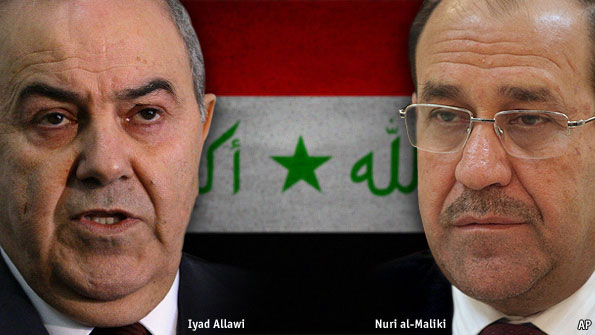
DAMASCUS – The streets of Baghdad were empty on Friday evening as the final results of the March 7 parliamentary elections were being announced. Elsewhere in Iraq, a terrorist attack in the suburbs of Diali province led to the killing of 45 people and the injuring of 65 – news that went by almost unnoticed when it was announced that Iyad Allawi’s Iraqi List (Iraqiya) had won the elections with 91 out of 325 seats in parliament.
Prime Minister Nuri al-Maliki, who has headed Iraq since 2006, has effectively lost his job, given that his State of Law Coalition won 89 seats, effectively bringing him into the opposition. A religiously driven politician, colored as a sectarian by his opponents and ridiculed at times by his own allies, Maliki will make way, in all likelihood, for Allawi – a secular Shi’ite and former Ba’athist. Once seen as a staunch ally for the United States, Allawi is now viewed as a national leader for Sunnis and Shi’ites alike.
Allawi, 65, served as premier from June 1, 2004 to April 7, 2005, following Saddam Hussein’s ouster in 2003.
The election results speak volumes about how far the country has come since the war of 2003 and since sectarian violence gripped Iraqis by the throat from 2006 to 2008. Iraqis at home and in the diaspora will be proud for choosing to change their fate through ballots rather than bullets.
Two years ago, Allawi’s chances of returning to power were close to zero. His pro-American past and secular agenda were seemingly unattractive to ordinary Iraqis mesmerized by the religious program of Shi’ite parties like the Supreme Iraqi Islamic Council (SIIC) or its Sunni counterpart, the Iraqi Accordance Front.
The SIIC and Maliki saw him as a political weakling, while influential Shi’ites like Muqtada al-Sadr vowed never to work with him given that he had crushed their uprising when serving as prime minister in 2004. Sunnis wrote him off as too secular for their tastes, too closely affiliated with the post-Saddam order that had been so dear to their hearts.
Iran was not too fond of the man, precisely because of his secularism, preferring instead to deal with heavyweight Shi’ites with a religious program, whom it could manage, like ex-prime minister Ibrahim al-Jaafari, Muqtada and Maliki.
Today, Allawi rises with the strong backing of both Sunnis and Shi’ites who see him as a savior, capable of putting an end to the lawlessness and security chaos that prevailed under both Maliki and his predecessor, Jaafari, both products of Islamic parties.
The fact that secular Allawi won while religiously driven Sunni and Shi’ite parties did not is testimony to a visible maturity on the Iraqi street. They now understand that those preaching a theocracy in Iraq – be it Sunni or Shi’ite – failed to bring in law and order. They had their chance in power and ultimately failed to keep it, letting petty sectarian rivalries dominate their agenda rather than a cross-sectarian nation-building program.
In Baghdad, for example, which controls the lion’s share of seats in parliament (a total of 70) Allawi came out with 24 seats, while the Sunni Accordance Front received no more than eight. The Iraqi National Alliance (INA), which is backed by Iran and includes both the Sadrists and SIIC, won only 17 seats in the capital.
In the heavyweight Shi’ite province of Karbala, Allawi not surprisingly got only one seat but yet the INA got only three whereas the majority (six seats) went to Maliki. There was a clear draw in the controversial oil-rich region of Kirkuk, where the Kurdistan Alliance and Allawi’s team each came out with six seats. In al-Anbar province, another Sunni stronghold, Allawi’s list won 11 seats, while the Accordance Front got only two.
Another surprising result was the visible retreat of the SIIC, the Sadrists and the INA as a whole; it now ranks as the third-largest bloc in parliament, having held an absolute majority from 2005-2009. They nevertheless managed to take three important provinces, winning six seats in Maysan, for example, and five in Qadisya, but failed to take the Shi’ite stronghold of Najaf, where they got only five seats, while Maliki’s State of Law Alliance came out with an impressive seven.
In total, the INA now controls 70 seats in parliament; 70 seats fewer than the 140 it commanded in 2005. Then, the INA, of which Maliki was a ranking member, won 140 of the 275 seats in parliament. However, due to the political weight of its members, it is a mistake to write off the INA as politically finished. It still commands a strong bloc and Allawi will need to come to terms with its leaders if he wants to create a cabinet of national unity.
No cabinet will be possible without the Iran-backed INA, explaining why many are now referring to it as a “king-maker coalition” that has the power to make or break the incoming prime minister. To date, no such crisis is on the horizon since both Ammar al-Hakim of the SIIC and Muqtada have accepted the election results and are seemingly willing to work with Allawi – if they are properly represented in his cabinet.
Muqtada has backed Allawi by flatly rejecting a recount of votes, accusing Maliki, who is crying foul play, of “political terrorism”. Meanwhile, Hakim called on his followers to reach deep into their souls to accept the results, noting that democracy should be respected even if it doesn’t mean absolute victory for the INA.
For his part, Maliki is sulking, claiming that the elections were rigged and demanding a hand recount of votes. The Higher Election Commission that oversaw the elections has flatly rejected his claim, so have international observers of the process and the United Nations, which explicitly said that no fraud took place.
Maliki insists that he is the legitimate prime minister and will proceed to form a new cabinet with his allies – a mad scenario that seems very unlikely since all serious politicians in Baghdad have already accepted Allawi as the new premier.
The ex-prime minister needs time to digest his defeat and retreat quietly to the opposition, working for a comeback the next time Iraqis go to the polls, in 2015. The US, which brought Maliki to power in 2006, is no longer interested in him – an embarrassing leftover from the George W Bush era who departs from office leaving behind a country torn apart by civil strife and sectarian violence.
The Syrians, who tried hard to help Maliki bring normalcy to Iraq, are upset with the man for wrongly blaming them of being indirectly involved in multiple attacks that rocked the Iraqi capital in August, October and December 2009. They prefer a strong and secular prime minister in power in Baghdad – someone who has the will and the way to bring security and stability, which reflects Syria’s vision for the new Iraq.
The Saudis, clearly supportive of Allawi during the election campaign, are also upset with Maliki for having systematically worked to alienate Sunnis from the political process since 2006. For its part, Iran also seemingly lost faith in Maliki. Rather than unite the Shi’ite front, Maliki created a coalition of his own in 2009, refusing to work with former allies like Hakim and Muqtada, who are backed by Tehran.
All of these players combined are now waiting to see what Allawi will offer Iraq and the neighborhood as a whole. The man has a reputation for being a strong leader, able to strike with an iron fist to root out militia rule, earning him in 2004 the nickname “Saddam lite”.
If he manages to do that, in addition to establishing a strong central authority in Baghdad while maintaining close ties to all of Iraq’s neighbors, there is no reason why Saudi Arabia, Syria and Iran will not support the new prime minister.
Domestically he has to walk the tightrope between Sunnis, Shi’ites and Kurds, which seems possible given that he is not dominated by a sectarian agenda, as was his predecessor, stemming from his upbringing as a secular Ba’athist.
Allawi brings hope to the Iraqi people – or amal, as is said in Arabic.
Sami Moubayed is editor-in-chief of Forward Magazine in Syria.
 Mohammed Abbasi