

‘Ignorance’ leads to botched Afghan raids
By Gareth Porter
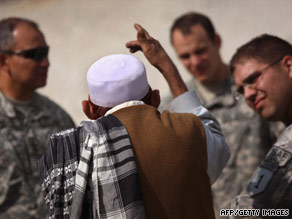
WASHINGTON – A Special Operations Forces (SOF) raid on February 12 on what was supposed to be the compound of a Taliban leader but killed three women and two Afghan government officials demonstrated a fatal weakness of the United States military engagement in Afghanistan: after eight years of operating there, the US military still has no understanding of the personal, tribal and other socio-political conflicts.
In targeting the suspected Taliban in such raids, therefore, the US military command has been forced to rely on informants of unknown reliability – and motives.
As a provincial council member from Gardez, near the scene of the botched raid, declared bitterly last week, US Special Forces “don’t know who is the enemy and who isn’t”.
When the commander of the Joint Special Operations Command, Admiral William McRaven, went to the site of the raid to apologize, the head of the extended family that lost five people to the SOF unit, Hajji Sharibuddin, demanded that the US military turn over “the spy who gave the false information to the Americans”.
General Stanley McChrystal and his chief of intelligence, General Michael Flynn, have admitted to the profound ignorance of the US military about Afghan society, while avoiding the implications of that ignorance when it comes to the issue of false intelligence onthe Taliban.
McChrystal acknowledged in his “initial assessment” last August that his command had to “acquire a far better understanding of Afghanistan and its people”.
In an interview with National Public Radio on August 13, Flynn admitted, “What we really have not done to the degree that we need to is really truly understand the population: the tribal dynamics, the tribal networks, the ethnicity.”
Such dynamics are different “from valley to valley”, Flynn observed.
And in an unusual paper published by the Center for a New American Security last October, Flynn was even more frank, saying, “I don’t want to say we’re clueless, but we are. We’re no more than fingernail deep in our understanding the environment.”
Flynn avoided any suggestion that this profound ignorance of the society in which US troops are operating could affect targeting of suspected Taliban. He asserted that the intelligence problem is not about the Taliban but about the lack of knowledge about governance and development issues.
But a foreign military force that is so fundamentally ignorant of the socio-political forces at play inevitably relies on local sources, which may act in their own self-interest.
More often than not, the US and North Atlantic Treaty Organization have depended heavily on ties with Afghan tribal leaders and warlords. That has proven disastrous over and over again.
Colonel David Lamm, who was chief of staff for General David Barno, the top US commander in Afghanistan from 2003 to 2005, has said that it became clear to top officials in the command that it should not make alliances with tribes to obtain information on the Taliban.
It often turned out that a group a tribal leader said was the Taliban was actually a competing tribe, Lamm recalled in a September 2008 interview with Inter Press Service.
Barno also ordered his commanders to shun local police as intelligence sources on the Taliban. “Local police were too close to the local elite,” said Lamm.
Despite such warnings, however, Central Intelligence Agency(CIA) and military intelligence operatives have continued to rely on tribal patriarchs and local warlords as intelligence sources on the Taliban. As recently as December 2008, US intelligence officials were telling Washington Post reporter Joby Warrick that their operatives had been using gifts of Viagra, among other inducements, to get warlords and tribal leaders to provide such intelligence.
The US military, including SOF units, have also relied on local warlords to provide security for their bases and logistics, as documented by a study by the Center on International Cooperation at New York University last September. Those ties translate into channels for intelligence as well.
The most egregious example is the CIA’s use of intelligence from Ahmed Wali Karzai, the brother of President Hamid Karzai, the chairman of the Kandahar province council and the most powerful figure in the province.
Rajiv Chandrasekaran reported in the Washington Post last September that US and Canadian diplomats had not pressed Karzai to dismiss his brother from his position, because he had provided “valuable intelligence” to the US military.
The inability of the US military to organize its own networks of reliable agents has also led to a willingness to act with lethal force on the basis of tips from dubious sources.
In the most widely known instance of mass civilian casualties from a US attack, an air strike on the village of Azizabad in Herat province in August 2008, Afghan officials expressed certainty that US commanders had been misled by a rival of clan leader Timor Shah, who had died some months before.
An investigation of the incident by the Afghanistan IndependentHuman Rights Commission revealed that a former business partner of Timor’s who still had personal enmity toward the family – and who had been involved in various criminal activities – had passed false information to Coalition Forces that there would be a big gathering of Taliban fighters in Azizabad.
The US command carried out a devastating bombing on what turned out to have been a memorial ceremony for Timor Shah. As many as 90 civilians, including 60 children, were killed in the attack.
United Nations rapporteur Philip Alston wrote in a May 2009 report that “numerous government officials” had told him that “false tips” had “often” caused night raids to result in the killing of innocent civilians. He reported that one provincial governor had “stated that there were people in his province who made a business acting as intermediaries who would give false tips to the international forces in return for payment from individuals holding grudges”.
Alston was told by a village elder in Nuristan that a district government had fed false information to “international forces” that led to a raid targeting his local opponents. He also said a similar incident in Nangarhar’s Ghani Khel district was reported to him.
Alston reported that a “senior official” who responded to his critical report did not deny that “feuds” drive much of the identification of local Taliban officials. Instead the official suggested that such “feuds” were simply “part and parcel of the conflict between the Taliban and the government”.
Instead of admitting that US intelligence was fatally flawed, the US military command had simply adopted a justification that did not require any real understanding of the society.
McChrystal, on the other hand, has lamented that ignorance but continues to authorize raids that are based on the faulty intelligence it generates.
Gareth Porter is an investigative historian and journalist specializing in US national security policy. The paperback edition of his latest book, Perils of Dominance: Imbalance of Power and the Road to War in Vietnam, was published in 2006.
(Inter Press Service)
 Mohammed Abbasi