

By Syed Saleem Shahzad
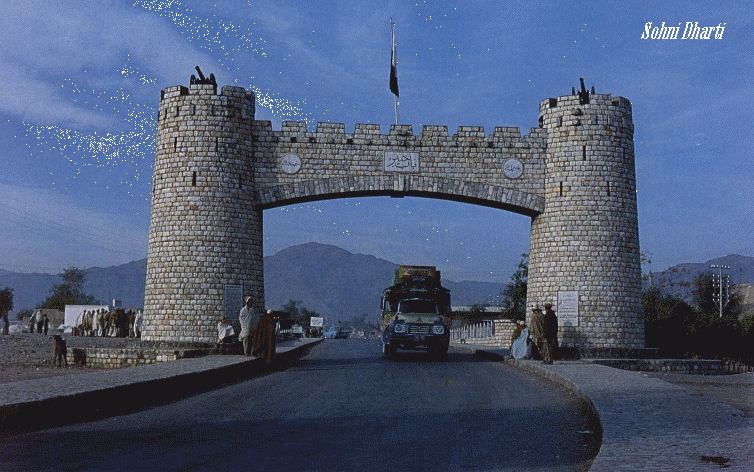
ISLAMABAD – The move to change the name of restive North-West Frontier Province (NWFP) to Khyber Pakhtoonkhwa – meaning “Khyber side of the land of the Pakhtuns” – to reflect the majority ethnic Pashtun population of the province has stirred a violent backlash that adds another layer to the myriad problems Pakistan faces.
More than a dozen people have been killed in the past week in clashes between the security forces and non-Pashtun protesters in NWFP.
After a two-day debate, the senate on Thursday passed the 18th amendment to the 1973 constitution that instituted the name change. Other amendments that are still awaiting approval would result in the president being stripped of sweeping powers, including a transfer of powers from the Office of the President to the prime minister, taking away, including other things, the president’s power to dismiss an elected government and appoint military chiefs. The National Assembly last week passed the amendment.
The amendments will undo the presidential powers instituted by former military dictators General Zia ul-Haq and General Pervez Musharraf and significantly empower parliament; marking one of the most important pieces of legislation in Pakistan’s recent history.
The sub-nationalist Pashtun Awami National Party (ANP), which leads the coalition government in NWFP, in return for its support of the presidential changes insisted that NWFP’s name be changed at the same time.
This has been a long-standing demand of the party as well as its predecessor, the banned National Awami Party, which was the initial flagbearer of a greater Pakhtoonistan – the name given to the region inhabited by Pashtuns since ancient time that straddles modern-day Pakistan and Afghanistan.
The area was designated as a future sovereign state by Khan Abdul Ghaffar Khan (known as Frontier Gandhi and the grandfather of Asfandyar Wali Khan, the current leader of the ANP) in the late 1940s when British India was in the process of being partitioned. Instead, much of it was incorporated into Pakistan when the new country was established in 1947.
Pashtun nationalists say the historic homeland was first divided in 1893 by the Durand Line, a disputed and what they call an imaginary border between British India (now Pakistan) and Afghanistan. The line still serves as the de facto border.
After the fall of the Soviet Union in 1991, the ANP changed its political position and even made alliances with its historical rival, the Pakistan Muslim League. It also publicly recognized the creation of Pakistan and Mohammad Ali Jinnah, previously a political opponent, as its spiritual leader and the father of nation. Jinnah served as Pakistan’s first governor general.
The ANP completely distanced itself from its traditional anti-American policies that were born during its closeness to the Soviet camp during the Cold War. After the September 11, 2001, attacks on the United States, the ANP emerged as an important US ally and its support of the “war on terror” made it a prime target of the Taliban and al-Qaeda.
After prolonged and heated debate inside and outside parliament, all the major stakeholders, including the ruling Pakistan People’s Party and the opposition Pakistan Muslim League-Nawaz, agreed that NWFP’s name change to Pakhtoonkhwa would not revive the old controversy of Pakhtoonistan.
The issue has however stirred passions among the frontier province’s minority non-Pashtuns in the population of about 21 million. Violence has reached such levels that entire non-Pashtun majority regions are paralyzed. The ANP-led government has responded with force, with unconfirmed reports of about a dozen deaths.
Two other communities, those speaking the Hinko and Siraiki languages, have rejected the name change. In the past few days, thousands of people have taken to the streets of Abbotabad and Mansehra in protest. In the latest twist, people of the region of Hazara have demanded a separate province for the non-Pashtun population.
Protesters have ransacked ANP offices and targeted office bearers. Portraits of the party’s founders have been smashed and its red flags, red shirts and red caps set on fire. The former ruling pro-Musharraf Pakistan Muslim League (Quaid-Azam) joined the protests and declared the ANP’s leaders traitors. Before partition, the ANP’s early leaders had been a part of the Indian National Congress that opposed the creation of Pakistan.
“Nobody expected such a reaction in this renaming drama. Now a crisis looms large,” Dr Meraj ul-Huda, a senior leader of the Jamaat-e-Islami, a premier Islamic party, told Asia Times Online.
“The political leadership should have realized the fact that Pakhtoonkhwa would not be acceptable in several areas and that it would only create further complications – which seem inevitable now,” Meraj said.
“Already, the Hazara region has put in a demand for a new province. This will not be acceptable to the Pashtun population or the Awami National Party. But the Hazara region now appears to be rigid in its demand,” Meraj said, adding that even worse was a fresh demand from the tribal areas situated between Pakistan and Afghanistan for a separate province, Kabailistan (Land of Tribes).
“The most dangerous aspect of this controversy is that the ANP aims to implement its demand of Pakhtoonkhwa by keeping the whole province as one entity by any means possible, using brute force instead of political dialogue,” Meraj said.
Splittist sentiment is spreading fast.
There are now calls for a separate Siraiki province to be carved out of Punjab. This is likely to be turned into a movement in the coming weeks. In the southern port city of Karachi, the Mohajir Qaumi Mahaz (MQM – Mohajir National Movement) has raised the possibility of splitting from Sindh province and turning Karachi and Hyderabad into a separate province.
These splits are not likely to happen any time soon. But what is worrying for the military establishment is that the flagbearers for these separate entities have traditionally been accused of being Indophile and have generally sat lightly in the American camp. The heat being raised by Pakhtoonkhwa provides them with an opportunity to stir the rabble.
Security contacts tell Asia Times Online that should such mass protests eventuate, the military is considering reviving right-wing Islamic parties as a counter force.
Syed Saleem Shahzad is Asia Times Online’s Pakistan Bureau Chief. He can be reached at saleem_shahzad2002@yahoo.com
(Copyright 2010 Asia Times Online (Holdings) Ltd.
 Mohammed Abbasi