

By Syed Saleem Shahzad
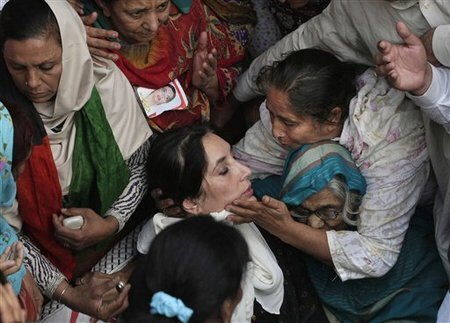
ISLAMABAD – Pakistan has suspended eight police officials following the release of a United Nations report into the assassination of former prime minister, Benazir Bhutto, but no action has been taken against any members of the military or intelligence agencies, even though the report implicates the military in the events surrounding Bhutto’s death on December 27, 2007.
“The failure of the police to investigate effectively Ms Bhutto’s assassination was deliberate,” the report found.
There has also been no official response to the report’s suggestion that the Pakistan authorities should investigate the al-Qaeda connection in the assassination plot. The 70-page report, made public by an inquiry commission established by the UN last July, specifically mentions an article by Asia Times Online in making this suggestion. (See Al-Qaeda claims Bhutto killing December 29, 2007.)
Bhutto’s assassination after leaving a campaign rally in the garrison city of Rawalpindi two weeks before general elections has been the subject of intense controversy, and while the report does not give any definitive answers it is most likely to intensify divisions between the ruling Pakistan People’s Party (PPP) and the military establishment, both of which are tainted by the report.
Current officials, the report says, were less than helpful. “The investigation was severely hampered by intelligence agencies and other government officials, which impeded the search for the truth,” Heraldo Munoz, chair of the Bhutto Commission of Inquiry and permanent representative of Chile to the UN, said. “These officials, in part fearing intelligence agencies’ involvement, were unsure of how vigorously they ought to pursue actions which they knew, as professionals, they should have taken,” he said.
The commission’s report, based on interviews with 250 people in and outside Pakistan as well as other evidence, says the official investigation focused on “low-level operatives and placed little or no focus on investigating those further up the hierarchy in the planning, financing and execution of the assassination”.
The report says the killing was carried out by one teenage suicide bomber who also fired shots. However, Pakistani investigators have always insisted that at least two people were involved – the bomber and the person who fired.
Bhutto – who had twice been premier (1988-1990 and 1993-1996) – had recently returned to Pakistan after living in exile for about eight years. The three-member commission’s report notes that Bhutto faced threats from a number of sources, including al-Qaeda, the Taliban, local jihadi groups and “potentially from elements in the Pakistani establishment”.
The PPP, which Bhutto led and which is now co-chaired by her widower, President Asif Ali Zardari, has threatened to take action against former military ruler, General Pervez Musharraf, who was president when Bhutto was killed. PPP leaders resolved in a statement to expose and bring to justice all those, including Musharraf, “who planned, abetted and indulged in the criminal act, screened off the offenders and destroyed the evidence”.
One of the officials removed includes a senior police officer, Saud Aziz, who ordered the scene of the murder to be hosed down and who the report says destroyed invaluable evidence. The report suggests Aziz was acting under the direction of the then head of the military intelligence agency, Major General Nadeem Ijaz Ahmad, who still has a senior job in the Pakistani army and who was known to be very close to Musharraf.
One of the PPP’s leaders, Senator Rahman Malik, who is Interior minister, comes under fire in the report. Malik has always claimed that at the time he was Bhutto’s national security advisor, not in charge of her physical safety, but the report found evidence that Malik did in fact oversee Bhutto’s entire security arrangements.
One of the most controversial characters to emerge from the report is the former military intelligence chief, Ijaz, who is now Log Area Commander Gujranwala. While the report refers to his close ties to Musharraf, it does not mention that at the time of the assassination Ijaz, by virtue of his designation and the hierarchy of the army, would have had lines of communication that went directly to the chief of army staff, General Ashfaq Parvez Kiani, who still holds the post.
Lieutenant General Nadeem Taj was at the time of Bhutto’s death the director general of the Inter-Services Intelligence, which also came out badly in the report. Taj is now Corps Commander Gujranwala.
The accusations against the military and the intelligence services, that they facilitated security loopholes or that they covered up evidence, reflect badly on these institutions as a whole and can be expected to cause fresh civil-military polarization in Pakistan.
An assassination unfolds
At the time of her death, Bhutto was vigorously campaigning around the country, following the November 20 announcement of general elections to be held on January 8. She had returned to Pakistan from exile in October, after a US-brokered deal with Musharraf gave her immunity from charges of corruption during her previous terms as prime minister. In return, her PPP supported Musharraf’s bid to be re-elected as president.
In election speeches Bhutto lambasted Islamic extremism and asked the people to stand against it. She also regularly spoke against al-Qaeda and had supported Musharraf’s bloody crackdown in July 2007 on the radical Lal Masjid (Red Mosque) in Islamabad that had become a focal point for militants
After the Lal Masjid incident, al-Qaeda leader Osama bin Laden assigned Abu Obaida al-Misiri as Amir-e-Khuruj (commander for revolt) and, when Bhutto started to hit the headlines, Misiri was assigned to take her out.
Among others, he set up a cell in Rawalpindi specifically tasked with killing Bhutto. Among its members were Aitzaz Shah, Hasnain Gul, Rifaqat, Sher Zaman and Abdul Rasheed, all of whom were subsequently arrested.
A senior Pakistani security official who interrogated all five, at least three times, told Asia Times Online that this cell was active in Rawalpindi for several months before Bhutto’s assassination, including an attack on a police check post in Golf Road that leads to military headquarters (GHQ Rawalpindi).
“These young men were a by-product of a time when the Tehrik-e-Taliban Pakistan [TTP – Pakistani Taliban, formed in late 2007 and early 2008] was not around. They were zealous for jihad and they joined the [Jalaluddin and Sirajuddin] Haqqani network in North Waziristan [tribal area],” the security official said.
“While there, they interacted with different militant organizations and they finally landed in a group that was a nexus between Pakistani militant organizations [known as Punjabi fighters], al-Qaeda and Baitullah Mehsud [who was to become head of the TTP. They were assigned to go to Rawalpindi to support the cause of al-Qaeda.
“When the two suicide bombers, Ikramullah and Bilal, were sent from South Waziristan [to kill Bhutto], the cell facilitated them. They arranged their residence and helped them in the preparation of the attack. They [the cell members] were the backup of the attackers and if the attackers failed, they would have done so,” the official said.
Although in the narrow sense Baitullah Mehsud supplied the attackers, at the broader level it was an al-Qaeda plan that had been discussed at length by the al-Qaeda shura (council), which decided that there was a religious justification for killing Bhutto and that her death could deal a setback for the interests of the United States in the region.
The National Reconciliation Ordinance (NRO), which came into effect in October 2007, was a deal brokered by London and Washington as a part of a broader plan to introduce a liberal, secular and democratic government in Pakistan that would faithfully support the “war on terror”.
The NRO, which was overturned this year, granted amnesty to politicians, political workers and bureaucrats who were accused of corruption, embezzlement, money laundering, murder and terrorism. Two of the main beneficiaries were Bhutto and her husband Zardari, who were cleared to return to Pakistan, with Bhutto earmarked to lead the new government.
Bhutto’s killing put an end to that plan, while Musharraf was also a loser as he lost control of the helm and eventually resigned in August 2008, paving the way for Zardari to take over a month later.
While al-Qaeda clearly orchestrated the killing of Bhutto, the UN’s report implies that the security forces did not prevent the attack (the report uses the term malafide) and that after the murder, the report implied, in order to cover this up, the security forces washed away all the evidence from the murder site.
Immediately after Bhutto’s assassination, a Musharraf government spokesperson came out with an intercept of a tape between Baitullah Mehsud and militants that inferred that the attack was carried out on the instructions or with the coordination of Baitullah Mehsud, and therefore everybody pointed a finger at him. The UN report also documents that the Pakistan Military Operations had given an advance warning on December 21 that bin Laden had given an order for Bhutto’s killing.
Syed Saleem Shahzad is Asia Times Online’s Pakistan Bureau Chief. He is writing an exclusive account of al-Qaeda’s strategy and ideology in an upcoming book 9/11 and beyond: The One Thousand and One Night Tales of Al-Qaeda. He can be reached at saleem_shahzad2002@yahoo.com
 Mohammed Abbasi