

Militants write their answer in blood
By Syed Saleem Shahzad
ISLAMABAD – When villagers of Karamkot near the town of Mir Ali in Pakistan’s North Waziristan tribal area on Friday came across a bullet-riddled body they thought at first it was just another little-known person killed by militants on suspicion of being a traitor, as often happens in the area.
The tag attached to the body told another story: it was retired squadron leader Khalid Khawaja, a former Inter-Services Intelligence (ISI) official and a close friend of al-Qaeda leader Osama bin Laden during the resistance in Afghanistan against the Soviets in the 1980s.
He had been on a mission to mend ties between the Islamic forces of the country and the military establishment in an attempt to stave off a grand regional AfPak battle, the highlight of which would be the upcoming offensive in North Waziristan.
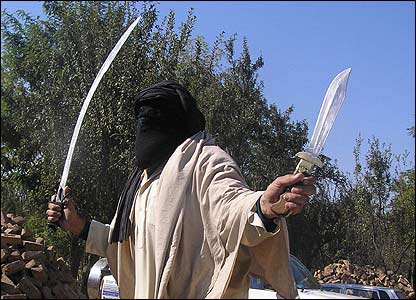
Pakistan’s showdown with militants and al-Qaeda now seems inevitable.
On March 25, Khawaja traveled to North Waziristan to interview Sirajuddin Haqqani and Waliur Rahman Mehsud, leading militants. He was accompanied by journalist Asad Qureshi and Colonel Ameer Sultan Tarrar, also a former long-time ISI official and once Pakistan’s consul-general in Herat in Afghanistan. Tarrar is nicknamed “Colonel Imam” by the mujahideen as he was instrumental in helping raise the Taliban militia.
Punjabi militants calling themselves the “Asian Tigers” claimed responsibility for the abductions. This month, Asia Times Online received several video clips of Khawaja speaking. (See Confessions of a Pakistani spy Asia Times Online, April 24, 2010.)
Pakistan’s toothless administration in North Waziristan sent a tribal jirga (council) with white flags to Karamkot to recover Khalid’s body and took it to the capital, Islamabad, where he was buried on Sunday. He was in his early 60s.
Pakistan has already moved 100,000 troops from the eastern border (near India) to the western borders in the tribal areas near Afghanistan and is reported to be waiting for the transmission of US$600 million in support funds from coalition countries fighting in Afghanistan.
On Sunday, the chief of the US Central Command, General David Petraeus, arrived in Islamabad to meet with Pakistan’s top brass to discuss plans for the operation in North Waziristan, home of the biggest Taliban-led group, the Haqqani network, as well as a headquarters of al-Qaeda. The operation is seen to be directly linked with the fate of the North Atlantic Treaty Organization’s (NATO) upcoming battle in the southern Afghan province of Kandahar. NATO is particularly concerned that its vital supply lines through Pakistan are protected.
For their part, the militants aim to spread the military as thin as possible, and terror operations have been revived in Peshawar and the Swat Valley. There was also a low-intensity bomb attack in Lahore on Saturday night. The Indian capital, New Delhi, has been placed on high security alert on fears of an attack.
Failed peace efforts
In January 2009, a lobby approached Baitullah Mehsud, the then-leader of the Tehrik-i-Taliban Pakistan (Pakistani Taliban – TTP), and urged him to write a letter to army chief General Ashfaq Parvez Kiani and seek a peace deal. The letter was to be delivered by a former parliamentarian, Shah Abdul Aziz, but before anything could happen Aziz was arrested and Mehsud was killed in a US drone strike.
Another initiative began in March, as explained by Pakistan’s former chief of army staff, General Aslam Beg, at Khawaja’s funeral service.
“Khalid Khawaja approached me in the first week of March before he went to North Waziristan. When he came back from North Waziristan he brought good information about the ground situation. He assured me that all top leaders of the militants agreed on peace with Pakistan and he told me that now the ball was in Pakistan’s court. However, nobody from the state machinery would meet with Khalid Khawaja. However, he was optimistic that his efforts would bear fruit and peace would prevail, but unfortunately he was killed when he visited the area a second time,” Beg said.
Khawaja’s murder would indicate that al-Qaeda is pulling the strings in North Waziristan. Other key groups had tried to get the so-called Asian Tigers to release Khawaja, Colonel Imam and Qureshi.
The Afghan Taliban, including those led by Mullah Omar from southwestern Afghanistan, Sirajuddin Haqqani (an Afghan Taliban based in North Waziristan) and the chief of the Taliban in North Waziristan, Hafiz Gul Bahadur (a Pakistan), all called for the release of the men.
However, the captors, militants who moved from South Waziristan after military operations there, would not budge. They have taken control of the town of Mir Ali and are closely allied with al-Qaeda and do not listen to the Afghan Taliban. The Afghan Taliban never believed Colonel Imam or Khawaja worked for the Central Intelligence Agency (CIA), but the al-Qaeda-linked militants believed so.
“Ahmad Shah Massoud [leader of the Northern Alliance assassinated by al-Qaeda in 2001] was also a practicing Muslim. He was also an old mujahid, but when he joined hands with the CIA, his murder was justified,” Usman Punjabi, a militant spokesman from North Waziristan, told Asia Times Online by telephone the day before Khawaja’s murder.
Many media outlets have accused Pakistani Ilyas Kashmiri’s 313 Brigade of being behind the murder. The brigade is an operational arm of al-Qaeda. However, Usman worked with Kashmiri a long time ago before he formed his own group.
Mullah Omar sent a delegation to North Waziristan to seek the unconditional release of Colonel Imam, known as the father of the Taliban as he trained many top leaders of the mujahideen during the Soviet invasion of Afghanistan in the 1980s, including Massoud, Gulbuddin Hekmatyar and even Mullah Omar. Usman had told Asia Times Online that he would let Colonel Imam go anyway as he was not involved in anything. The fate of Qureshi is in the balance.
Syed Saleem Shahzad is Asia Times Online’s Pakistan Bureau Chief. He can be reached at saleem_shahzad2002@yahoo.com
 Mohammed Abbasi