

VIEW: US-Karzai marriage of convenience –S P Seth
 There was some rethink in Washington about Karzai’s relative importance in the US scheme of things. And this was judged to be pretty high
The US relationship with President Hamid Karzai of Afghanistan has taken a full turn from berating to smooching — politically speaking. Not long ago, President Obama visited Karzai in Kabul to tell him some home truths about the sorry state of his country under his leadership. Obama wanted Karzai to lift his game.
Around that time, a number of American high functionaries had expressed their impatience with the lack of governance and the widespread prevalence of corruption in Afghanistan, with Karzai’s own brother, as governor of Kandahar, involved in all sorts of shady deals. Who will forget the reported undignified yelling at one time between Karzai, US vice president Joe Biden, and Richard Holbrooke, Obama’s special envoy to Pakistan and Afghanistan? And the US Ambassador to Afghanistan Karl Eikenberry described Karzai as “not an adequate strategic partner”.
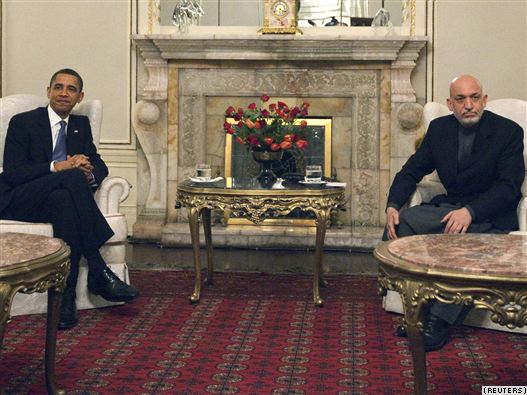
But all that was supposedly forgotten and washed off when Karzai paid a state visit to the US in May. He was accorded all the due state honours, met President Obama for a long conversation, this time as a friend and a partner, and without any kind of chastisement for not doing a good job.
Ambassador Eikenberry had a metamorphosis of sorts when he suddenly found that “the US and the Afghan governments have never been better aligned and had such seriousness of purpose in trying to reach our common objectives”. Reflecting President Obama’s revised estimation of his Afghan guest, the White House spokesman, Robert Gibbs, praised Karzai as “our partner in this battle against al Qaeda and their extremist allies”.
The question then is: what made the Obama administration revise its view of Karzai in a matter of a few months? Obviously, having created Karzai, they did not want to dump him unceremoniously. If needed, though, it would not have been all that difficult. But finding a replacement for Karzai would have been difficult.
Besides, since the US is keen to start withdrawing its troops from Afghanistan by the middle of next year, there is not much time to groom someone else for the job. In the meantime, Karzai has some cards up his sleeves. And he can make things pretty messy for the US, especially with the presidential elections due in 2012. Karzai is lousy at the governance of his country but smart at the Afghan game (tribal, ethnic and sectarian) of playing one against the other.
When the American pressure started on him to lift his game of governance, he clearly gave an indication of what he might be up to if pressed too hard. He threatened that he might join the Taliban-led insurgency to make it a ‘national resistance’ movement against foreign occupation. And he indicated that he might veto the planned US-led military invasion of Kandahar to flush out the Taliban from their stronghold. As it happens, Karzai’s brother is the governor of Kandahar and is known for all sorts of double-dealings.
At the time of the US-led military operations against the Taliban-held town of Marjah, there was a strong whiff of victory as the Taliban retreated. But this was a deceptive outcome, as the Taliban returned to effectively run the town as they had done before. General Stanley McChrystal’s promise of securing the population and providing them effective and honest administration was nowhere in sight. The people of the area were as scared or complicit with the Taliban as they were before.
After Marjah, the presumed successful outcome of the forthcoming Kandahar operations was supposed to put the Taliban out of business. In this heady atmosphere, Karzai did not seem fundamentally important. Describing the upcoming assault on Kandahar as “the cornerstone of our surge effort and the key to shifting the momentum’’, Admiral Mike Mullen, chairman of the US joint chiefs of staff, did not think that Karzai could really complicate things if he wanted to.
But the wily Karzai was planning to hold a jirga of tribal chiefs (starting soon) to discuss how best to integrate the Taliban into his administration. Whether or not this would have reached the actual point of the Taliban entering the Karzai administration is beside the point. The US did not want to conceive the possibility. It would have been like handing power on a platter to the Taliban. The US was not keen on it unless the Taliban renounced violence, and respected the Afghan constitution. Which is a non-starter.
In the midst all this, there was some rethink in Washington about Karzai’s relative importance in the US scheme of things. And this was judged to be pretty high, which led to him being invited to Washington and accorded all the pomp and ceremony. Karzai now is once again the US buddy — at least on the surface.
And he is quite happy. He would not last long with the Taliban who have always regarded him as an American puppet. The Americans knew that Karzai’s threats were mere bluster but they did not want to find out because he was their only visible Afghan face.
And what has Karzai got in return? He seems to have been assured that the US will not leave him and Afghanistan high and dry (even after they start withdrawing their troops in summer next year) and will continue to provide assistance with training and equipping his security forces (including police). He seems to have been also assured that Western aid for building Afghanistan’s economy and infrastructure will continue over an extended period of time.
Above all, the Americans will get off his back for the time being. For the Americans, having made him feel wanted and assured, they will not have to watch him threatening to fraternise with the Taliban, even as they carry out the operations against them in Kandahar.
But this new façade is a marriage of convenience and will not last. In other words, there is no respite for the Afghan people with all the protagonists and antagonists engaged in their power games.
The writer is a senior journalist and academic based in Sydney, Australia
 Mohammed Abbasi