

China bridges last Mekong gaps
By Brian McCartan
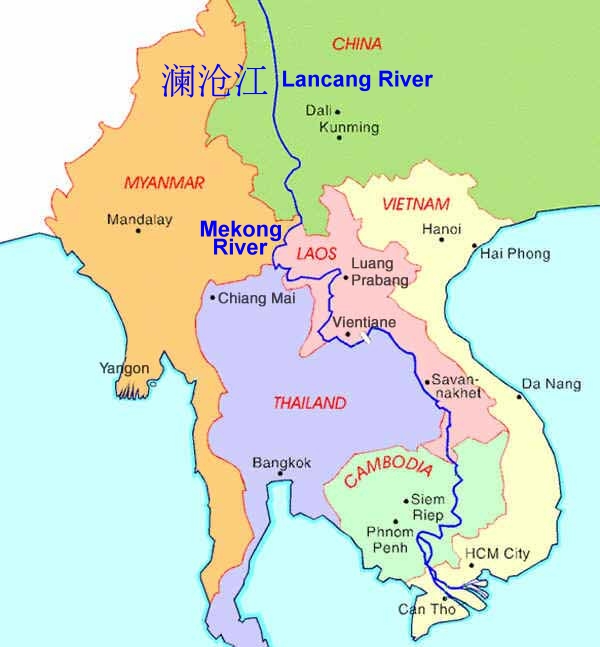
BANGKOK – The last remaining physical gaps on the north-south roadway set to connect China to Thailand and further afield through Southeast Asia will soon be bridged, opening a new land route that promises to expand intra-regional trade. China has recently agreed to finance the construction of two bridges across the Mekong River inside Laos, which until now have represented the regional project’s missing links.
Both bridges are key components of a grand infrastructure plan known as the Greater Mekong Subregion’s (GMS) North-South Corridor, which aims to create more efficient and rapid transport between China and Southeast Asia’s Cambodia, Laos, Myanmar, Thailand and Vietnam. The infrastructure is also key to the design of the Asian Development Bank (ADB)-funded Great Asian
Highway, which has been a priority of the ADB’s regional development agenda since 1993.
Lao state media reported on May 25 that China would provide a US$50 million loan for the construction of a bridge near the Lao town of Pakbeng, in the Southeast Asian country’s northern Oudomxay province and across from northern Thailand. The new bridge will link the two lane Route 2W with a new road extending from the Thai border to the river.
The long-term soft loan agreement was signed the previous week between Lao and Chinese officials. Math Sounmala, director of the Lao Ministry of Public Works’ planning and cooperation department, told the Vientiane Times that the bridge’s construction would commence soon and likely be completed before 2015. The approximately 600-meter long bridge is expected to replace the current ferry service across the river, which is now viewed as a bottleneck to fast and efficient trade.
Since undergoing improvements in 2004, the 2W is reportedly now in excellent paved condition. The two-lane road runs north to Oudomxay town in Laos where it connects to other throughfares leading north to the border crossing with China at Boten and east to the Vietnamese border and onto Hanoi.
Thailand has given Laos $25.9 million in grants and loans to build a 49-kilometer road linking the bridge with a border crossing at the Lao village of Mong Ngeun in Xayaboury province. From there, an existing two lane road continues from the Thai village of Huay Kon to the provincial capital of Nan and onward to Thailand’s extensive domestic road network leading to modern ports and other trade facilities.
A long-delayed fourth bridge across the Mekong connecting northern Thailand and Laos is also planned. The 480-meter long bridge represents the last link in a route known in Laos as National Route 3 or regionally as Asia Highway 3 that will connect Thailand with southwestern China running through northwestern Laos. The bridge will be built near the Thai town of Chiang Khong in northern Chiang Rai province and the Lao town of Huay Xai in Bokeo province.
China’s minister of commerce and the Thai minister of finance signed an agreement for the construction of the bridge during the 15th Association of Southeast Asian Nations Summit held at the Thai resort town of Hua Hin in 2009. Chinese Prime Minister Wen Jiabao, Lao Prime Minister Bouasone Bouphavanh and Thai Prime Minister Abhisit Vejjajeva oversaw the signing.
A further agreement on the operators of the construction project was signed by representatives of the Lao and Thai governments in Thailand’s Chiang Rai province on May 14. China’s Railway No 5 Engineering Group and the Thai Krung Thon Engineers’ Company will jointly build the bridge as the CR5-KT Joint Venture Group. The cost of the $43 million project will be split evenly by the Thai and Lao governments.
China provided a $20 million grant to Vientiane in 2008 to cover its share of the costs of the Chiang Khong-Huay Xai bridge. That project is slated for completion by late 2012, though construction has been delayed several times in the past and many observers doubt the deadline will be met. Disagreements among the three countries over the project’s budget, the global financial crisis and political instability in Thailand have all contributed to delays.
As of late May, little had been done apart from leveling dirt roads running to the site on both sides of the border. Although the project had been proposed repeatedly by successive Thai governments since the 1980’s, this is the closest the three countries have come to actually building the bridge. Cold War-era tensions between Thailand and Laos, as well as long-standing border disputes, have frequently put the project on hold. While bilateral relations have improved greatly since a short 1988 border war, a general reluctance among Thai investors has since stalled progress.
For Vientiane, the roads promise to change Laos from being “land-locked to land-linked”, strategically positioning the country as a regional trade crossroads. China and Thailand believe the routes will open up new trade and business opportunities in some of their poorer remote regions. China in particular sees the north-south roads as an opportunity to open up its landlocked southwestern Yunnan region to Southeast Asian markets and ports.
Asia Highway 3 was officially inaugurated in March 2008 at the GMS’s 3rd Meeting in Vientiane. The $97 million project was financed with a loan from the ADB and funds from China, Thailand and Laos. Thai and Chinese construction companies built the road that has shortened travel times between the Chinese border town of Boten and Huay Xai on the Lao border with Thailand from two days to five to six hours.
A third route off the North-South Corridor is scheduled to be built through Myanmar, but has been hampered because it would pass through territory where armed insurgents are active. The northernmost portion of the proposed road and the border crossing with China at Mong La are controlled by an ethnic armed militia that currently has a very tenuous ceasefire agreement with Myanmar’s military government.
Over the river, into the woods
Both Asian Highway 3 and Route 2W are expected to replace much of the current riverine shipping down the Mekong, including from ports near Jinghong in China to the Thai river port of Chiang Saen. Dominated by Chinese river vessels, goods can take three days or more to transit, depending on water levels.
The route is also sometimes closed when the river’s depth drops below levels considered safe for navigation. This occurred earlier this year after a severe drought in southwestern China caused record low water levels on the Mekong. There is further concern in Thailand and Laos that Chinese dams built on the upper reaches of the Mekong may restrict water flows and contribute to low levels. China has denied that the dams are adversely affecting the river’s depth.
For the moment, some freight shippers still prefer the river route because it skirts Laos’ notoriously complicated and corrupt customs procedures. These and other restrictive regulations, including multiple tariffs applied on goods transported along the various roads connecting China and Southeast Asia across Laos, will need to be resolved before road routes are seen by traders as more cost competitive. Some Thai business leaders and development officials have suggested this could be remedied by a single stop inspection system for goods transported through Laos.
The Lao government, however, may be wary of waving transit fees and customs duties, which it sees as a key economic benefit of the new roads. This will change, however, as the Association of Southeast Asian Nations (ASEAN) increases pressure on its member states to reduce tariffs in line with both the ASEAN Free Trade Agreement (AFTA) and the ASEAN-China Free Trade Area, which will come into force for Laos in 2015. Laos is expected to have reduced tariffs to AFTA acceptable levels of between 0-5% by 2015.
Accurate trade statistics for Laos are scarce. Informal trades and an inefficient customs and statistics-keeping administration skews the figures that are available. Regardless, the Lao government seems to expect that new, more efficient trade links will lead to expanded trade and investment which together with an economic development plan focused on natural resource exploitation will offset loses from reduced tariffs.
Still, some fear that without effective regulation the new routes will also result in an unsustainable influx of cheaply produced Chinese goods, low-priced agricultural products and big waves of economic migrants. Rights advocates and development workers already say greater efforts are required to ensure people living in northwestern Laos also benefit from the roads and to mitigate the potential negative social impacts of accelerated travel and trade.
There are already reports about land grabbing along the main new route, as influential business people obtain territory near the Asia Highway 3 or launch new businesses alongside it. The road will also open previously closed areas to human trafficking syndicates, communicable diseases such as HIV/AIDS and possible over-exploitation of the surrounding forests and wildlife resources from Thai and Chinese business interests, activist groups warn.
A related concern is a possible surge of inward Chinese migration. Some have already arrived in Laos as workers on the new roads and many have stayed on to open shops and guesthouses catering mainly to other Chinese. Certain Lao towns, especially Oudomxay and Laung Nam Tha, have recently developed a distinct Chinese character, stoking resentment among some local residents.
While China and Thailand will definitely benefit from the expanded trade, Laos may ultimately lose out because many of the goods transported along the route will be destined for wealthier destinations in Thailand, China and Vietnam. Truck drivers may only stop in Laos for food, gas and rest.
For Thailand, the risks are a rapid increase in economic migrants from China and even greater competition from cheaper Chinese-made goods and agricultural products. Thai politicians have complained that a free trade agreement with China has put pressure on Thai garlic farmers who can’t compete on price. Some observers have therefore speculated that Thai foot-dragging on the construction of the Chiang Khong-Huay Xai bridge has had more to do with putting the brakes on Chinese economic inroads than official indifference.
Others in Thailand believe that increased trade and investment with China will bring net-net economic benefits. Either way, it seems certain that when the new Mekong bridges in Laos and other road links are finally completed, China’s influence in Southeast Asia, through trade, investment and migration, is only set to grow.
Brian McCartan is a Bangkok-based freelance journalist. He may be reached at brianpm@comcast.net.
 Mohammed Abbasi