

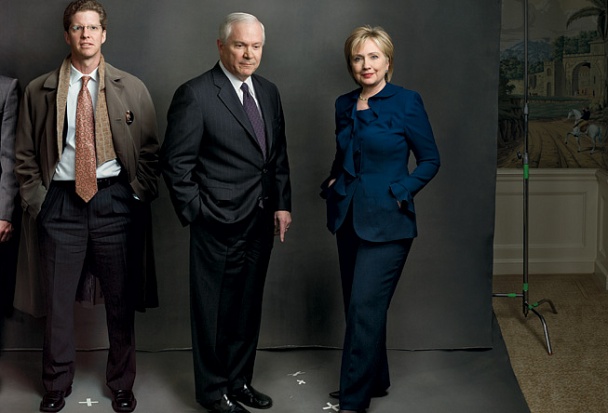
The shakeup in the senior command of the United States military in late June from the surprise resignation of General Stanley McChrystal could not have been predicted. Another change in command, involving US Secretary of Defense Robert Gates, will come as no surprise, though the exact date Gates plans to step down remains a mystery.
In a television interview aired on Fox News Sunday in late June, anchor Chris Wallace tried unsuccessfully to get Gates to specify whether he would be leaving his post in late 2010 or would remain until 2011.
Gates would not commit to a definite date, and even joked that his decision to possibly stay on and take part in the next round of heated budgetary politics on Capitol Hill in Washington may have resulted from the fact that he “didn’t want to get bored”. [1]
As far as US-China relations are concerned, Beijing is aware that someone else will be running the US defense establishment, but the Chinese government harbors no illusions: change in leadership at the Pentagon will not bring a fresh start. There is a sense that China would like Gates to go sooner rather than later. After all, Gates was subjected to a visible and abrupt snub by being denied a formal invitation to visit Beijing on his latest trip to Asia. Gates has also frequently spoken out about the threat posed by the Chinese military.
Still, Gates influences but does not direct defense policy in the administration of US President Barack Obama, and he is not the chief architect of a US military strategy which appears increasingly to challenge China at every turn.
“This tougher edge to US policy is a well-coordinated decision and is designed to respond to specific concerns that the US has about Chinese behavior in some areas,” said Bonnie Glaser, senior fellow and Freeman Chair in China Studies at the Washington, DC-based Center for Strategic and International Studies. “It does not mean, however, that the Obama administration is no longer seeking a positive, cooperative and comprehensive relationship with Beijing or that it has given up hope of cooperating with China on issues where our interests overlap.”
China is not pleased by everything that Gates says, but has come to accept that he has a measured role to play.
“I doubt that the Chinese are launching a campaign to oust Gates (because) they do not expect that they will ‘like’ a new US Defense Secretary better,” said Glaser. “Some of the US Department of Defense’s positions have been welcomed by China – the Quadrennial Defense Review and the Nuclear Posture Review, for example have contained some changes that the Chinese view as positive.”
When it comes to matters affecting the US’s overall strategy, force structure and military posture in Asia and elsewhere too, Gates has always been an astute and consistent team player, and someone who greatly values the opinions of others on his team.
Sorting through fact and fiction here is important given the steady deterioration of military-to-military relations between China and the US in particular. The current downward slide was prompted by the US decision to go ahead with arms sales to Taiwan.
“The Chinese are first and foremost concerned about US policy, which is formulated by the president, not the secretary of defense,” said Glaser. “President Obama approved the arms sale to Taiwan. Gates was one of several cabinet secretaries who recommended that the president proceed with the sale.”
Keep in mind that the Chinese were really never fond of former secretary of defense Donald Rumsfeld either. “They probably liked him less,” said Glaser. So Gates, the former Central Intelligence Agency director, was like a brief ray of sunshine when he assumed his post in 2006.
“As for Gates, I have never heard anything particularly positive or negative [from the Chinese], though I heard lots negative about Rumsfeld, so perhaps silence is positive,” said Joan Johnson-Freese, chair of the National Security Decision Making Department at the US Naval War College in Rhode Island.
China’s anger over the US$6.4 billion weapons sale to Taiwan is not diminishing, and the impact on US and China military-to-military relations is readily apparent. If nothing else, the sale has revealed a tendency by China to participate in mil to mil sessions with very low expectations and limited enthusiasm.
In February, Professor Yan Xuetong, head of the Institute of International Studies at Tsinghua University in Beijing, for example, openly questioned the fundamental purpose of these meetings. The Chinese military had always viewed the contacts as beneficial to both sides, according to Yan, but China soon realized that it gained really little or nothing from these ongoing military exchanges.
Adding to China’s mounting sense of frustration was the notion that US “military hostility to China” persisted, and that nothing was going to prevent the US from continuing its incursions in the South China Sea, conducting what the Chinese deemed as overt and intrusive military intelligence-gathering missions. [2]
Whenever the US does something that angers China, Beijing rapidly and routinely reacts by suspending military-to-military relations immediately anyway. This happened, for example, after the US bombed the Chinese Embassy in Belgrade more than a decade ago, killing several Chinese.
According to Gregory Kulacki, senior analyst and China project manager for the Global Security Program at the Massachusetts-based Union of Concerned Scientists, Gates has exhibited a lack of understanding of the relationship between the Chinese Communist Party (CCP) and the People’s Liberation Army (PLA).
“The PLA is the CCP’s army. Their allegiance is not to the Chinese state, but to the party. If the CCP leadership wanted mil-to-mil exchanges, the PLA would implement them. The lack of progress noted by Secretary Gates is most likely not a product of PLA intransigence, but a sign that the CCP leadership does not want to engage in military exchanges with the US,” said Kulacki.
Why the CCP is reluctant to engage is a complicated question that is difficult to answer given the lack of transparency that cloaks defense-related issues in China, but Kulacki doubts that it is connected to questions about arms sales, naval exercises or various other foreign policy issues that have been mentioned by US analysts.
“My own view is that the CCP’s reluctance to allow broader military exchanges with the US is connected to concerns about political legitimacy and fears that broader military exchanges with the United States might weaken the party’s ideological control of the PLA,” said Kulacki, who has identified a tendency among US analysts and policymakers who lived and worked through the Cold War to interpret Chinese behavior through their experience with the Soviet Union.
“They believe that the type of mil-to-mil exchanges they successfully managed with the former Soviet Union indicate a similar level and type of exchanges should be possible with China,” said Kulacki. “The relationship between the PLA and the CCP is different – historically and culturally unique. Gates might be more successful in engaging China on military issues if he studied those differences more carefully and took them into account.”
Gates does benefit from the consistency of the Obama administration that has left the Taiwan Relations Act (TRA) untouched, for example.
“Gates plays a role in this, but the president sets policy, not Gates. The US continues to have an abiding interest in preventing China from coercing Taiwan into making decisions that it would not make otherwise,” said Glaser. “The Chinese military buildup against Taiwan continues; faced with the growing military threat, the US has the obligation [under the provisions of the TRA] to sell defensive weapons to Taiwan.”
Simply put, Gates is not responsible for stewarding the TRA on his own or crafting a set of tougher complimentary measures designed to keep China in check and off balance. When Gates ends his last day of work at the Pentagon, the sun will rise the next morning and the US commitment to Taiwan will be unchanged and unchanging. According to Glaser, the TRA remains healthy and robust.
“The TRA continues to be a core component of US policy toward the cross-strait issue. Obama made this clear even before he was elected president,” said Glaser.
On the other hand, the language of the new US National Security Strategy issued in May has aroused many US conservatives to contend that this is proof that the Obama administration is trying too hard to engage China, and leaving any common sense behind. This abundance of US eagerness to engage China is not something that is necessarily favorable to the US, the argument goes.
“Why should an adversary bother to knock on our door and beg for entrance when we are going to come knocking and begging ourselves?” author Gabriel Schoenfeld recently asked on the Weekly Standard website.
Schoenfeld portrayed the US as engaging in “peculiar behavior” and practicing self-deception on a grand scale by overlooking the fact that, “deep antagonisms among states are rooted in geography, history, and ideology that jaw-jaw can often do little to resolve.”
In the process, the US exercises none of its substantial military and economic power, and too often appears weak rather than strong. [3]
Still, Gates played his cards in grand fashion as he outmaneuvered former Japanese prime minister Yukio Hatoyama, who left office earlier this year.
Goshi Hosono, the Democratic Party of Japan’s (DPJ) new acting secretary general, reassured an audience in Washington in mid-June, for example, that the US-Japan alliance was back on solid ground as a result. Hosono, who assumed his new post in May after the resignation of Hatoyama, stressed the importance of the security relationship while emphasizing the need for Japan to become more active in the region’s security.
According to Josh Rogin at Foreign Policy magazine’s “The Cable” blog, Hosono made a direct reference to the decline of US naval power as perhaps motivating Japan to become more actively involved in joint maritime security missions designed “to protect sea lanes.” [4]
That admission by Hosono may not have sent shockwaves down the halls of the Pentagon, but it did signal a shift in the DPJ’s attitude now that Hatoyama is no longer at the helm.
One cannot credit Gates with putting the brakes on the pro-China drift of the DPJ, but Gates might have caused the DPJ to ease the throttle back a bit. Still, any attempt by the DPJ to change course now might prove to be a waste of energy if the mid-July elections either strip the DPJ of its power or cause a drastic restructuring of the coalition.
In the South China Sea, where Gates has been spearheading the successful campaign by the US to make China appear overly imperialistic, Gates has done so in concert with his broader effort to cultivate ties with the Vietnamese and others.
“The Chinese are not so naive as to think that a new secretary of defense is going to result in changes in US surveillance operations in the South China Sea,” said Glaser.
There is a widely held view in the region and throughout the Obama administration that China is stepping up its presence and more assertively defending its claims, so as a result Gates faces a relatively easy task.
“The Chinese vice foreign minister told US officials that China sees the South China Sea as a ‘core interest’ and Gates’ remarks at the Shangri-La dialogue [in Singapore] warning the Chinese about intimidation tactics against US corporations and those nations that conduct legitimate economic activities represented a coordinated response from the Obama administration. Gates is not operating solo on this,” said Glaser.
Gates has been successful as a team player, and he will depart as a team player as well. He has not tried to upset China. Along with what he inherited in Iraq, Iran and Afghanistan, to name just three countries, his path simply crossed a rapidly ascending China.
Notes
1. Fox News Sunday Interview with Secretary Gates, US Department of Defense, Jun 20, 2010.
2. US arms sales to Taiwan stifle US-China military engagement, The Christian Science Monitor, Feb 2, 2010.
3. Why is the United States Always the Supplicant?, Weekly Standard, June 17, 2010.
4. Hosono: Washington can trust Japan again, Foreign Policy, Jun 21, 2010.
Peter J Brown is a freelance writer from Maine USA.
(Copyright 2010 Asia Times Online (Holdings) Ltd
 Mohammed Abbasi