

By Kaveh L Afrasiabi
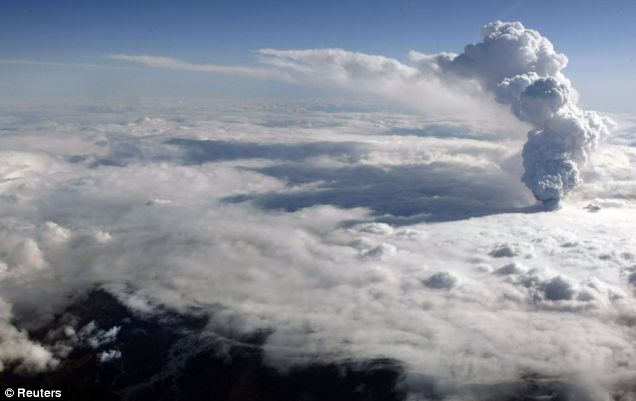
As one of the seven million or so travelers stranded by the flight shutdown caused by the Icelandic volcanic eruption, in addition to pondering the length of my delayed flight (four days behind schedule now), my thoughts are also focused on the long-term significance of this natural calamity.
The giant cloud of volcanic ash that has caused havoc to international travel, the European landscape and the global economy, once again reminds us of the fragility and downsides of an interdependent world.
With more than 70,000 flights canceled since last Thursday, including mine for a disarmament conference in Tehran, international air officials now say the economic impact for the airline industry surpasses that of the September 11, 2001 attacks. And there is no relief in sight.
Various reports indicate that the present situation may linger for several days or even weeks. When the Eyjafjallajokull volcano erupted some 200 years ago, it spewed dangerous ashes for a year. Not only that, some geologists are now openly warning of a second volcano in Iceland erupting with a velocity 20 times greater than the present one, in which case Europe would surely be thrown back to the pre-aviation age for quite some time.
Short of that nightmare scenario, the present predicament – with half the continent’s airports closed and more volcanic clouds drifting in its direction – could jeopardize the delicate economic recovery of European and many non-European countries.
The cloud of ashes may be lingering over Europe’s skies, but its destructive effect stretches like a venomous cloud over a much larger territory, in fact a decent chunk of our entire planet. This is due to the critical role that aviation plays in today’s architecture of global economic interdependence.
While it is too early to work out the total bill of the natural catastrophe, it is abundantly clear that some sectors – for example aviation and tourism – will be bit harder than others. However, even seemingly more insulated sectors will be affected in some way.
The scope of the damage may be so far-reaching that, according to a United Nations official, it could erode some of the recent gains against the 2009-2010 global economic slump. If so, this will set back the UN’s Millennium Development Goals. Indeed, the UN, so dependant on international flights for its summits and conferences, has been singularly affected by the effects of flight cancelations.
On the bright side, such a natural disaster for the world community is a reminder of how fragile the planet is, and of the importance of collective, global cooperation against such crises wrought by Mother Nature. Whether this helps to de-escalate international tensions over issues such as Iran’s nuclear program or in the Middle East peace process remains to be seen. However, it is quite clear that with Western leaders scrambling to deal with the unexpected natural disaster, they will be less focused on the various political crises. There is, in other words, an inverse relation between this crisis and the others that are man-made.
On the personal side, a few observations are needed on the mistreatment of the Third World passengers stranded in various European airports, which now resemble temporary internment camps. In Frankfurt, there are hundreds of passengers from countries such as China, India, Iran, Pakistan, or the Arab world who are not allowed to exit the airport, some with small children and most with no access to their luggage.
The German government has been dragging its feet on issuing temporary visas to such stranded passengers, while passengers for example from Russia have received the paperwork needed to leave the airport. The treatment is probably not limited to German airports, and passengers from developing nations stranded in other European airports are likely suffering the same ordeal.
The discriminatory treatment warrants urgent action by the European Union, which could be achieved by leaning on airports such as London, Paris or Frankfurt to grant more visas to stranded passengers. They could even provide better accommodation – in hotels rather than make-shift beds inside airports – and better meals.
The absence of flexibility on the part of German customs has meant, case in point, that hundreds of Iranian passengers coming from Iran en route to London cannot get out of the airport and reach their final destination by alternative means of transport. They have been suffering for days without adequate support and its not a proud moment for a temporary host government apparently more vexed about how deep this natural crisis will hit its pocket.
Kaveh L Afrasiabi, PhD, is the author of After Khomeini: New Directions in Iran’s Foreign Policy (Westview Press) . For his Wikipedia entry, click here. His latest book, Reading In Iran Foreign Policy After September 11 (BookSurge Publishing , October 23, 2008) is now available.
 Mohammed Abbasi
Great possessions as usual…